
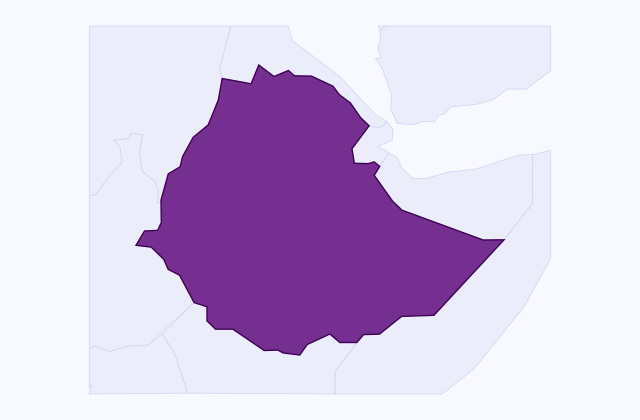
Adoption
Chapter Ten of the Revised Family Code (Proclamation No. 213/2000) says that adoptive filiation is created by an agreement between a person and a child (Art. 180), signed by the adopter and the child's guardian (Art. 190) and without effect until a court approves it (Art. 194(1)). Only a person under 18 who is under guardianship can be adopted (Art. 185), and the adopted child is treated as the adopter's child for all purposes (Art. 181) while keeping the bonds with the family of origin (Art. 183(1)). The Code binds the administrations answerable to the federal government, that is Addis Ababa and Dire Dawa; the regional states have enacted their own family codes.
An adopter must be at least 25, and where two spouses adopt together it is enough that one of them has reached that age (Art. 184). A married person may not adopt alone unless the spouse is unable to express a will or the child is the spouse's own (Art. 186), and nobody may be adopted by several persons unless they are two spouses (Art. 189(1)). A child merely conceived may be adopted, but the mother can withdraw unilaterally within six months after the birth (Art. 187). Both parents must consent while they are alive and known (Art. 191(1)); if one refuses and the child is ten or older, the court may approve after hearing the other parent and the child (Art. 191(3)). Government and private orphanages may place children for adoption after informing the authority that follows children's welfare about the child's identity, how the orphanage received him or her and the adopter's personal, social and economic position (Art. 192). Before approving, the court must be satisfied that the adoption serves the child's best interest and must consider the child's opinion, the guardian's opinion and the adopter's capacity to raise the child (Art. 194(2)-(3)). An adopter's own children are no obstacle, though the court weighs their effect on the adopted child (Art. 188).
The Code keeps the roots of an adopted child: the child, his or her spouse and descendants retain their bonds with the family of origin, and the family of adoption prevails where a choice must be made (Art. 183). An adoption has no effect towards the adopter's ascendants or collaterals who expressly opposed it, provided the opposition is registered at the court within one year of approval (Art. 182). Maintenance claims against the family of origin are barred unless the adoptive family cannot pay (Art. 212). The Civil Code of 1960 adds that adopted children are assimilated to other children for succession (Art. 836(2)). Revocation is exceptional: the court may revoke only where the adopter treats the child as a slave or in conditions resembling slavery, makes the child engage in immoral acts for the adopter's gain or otherwise harms the child's future (Art. 195), on a petition by the child, a government body charged with children's welfare or any interested person (Art. 196).
The foreign-adopter rules of the 2000 Code were removed by the Revised Family Code (Amendment) Proclamation No. 1070/2018, a three-article text signed on 14 February 2018: it repealed Art. 193, under which a court could approve a foreign adoption only on the favourable opinion of the child-welfare authority, and deleted Art. 194(3)(d) and (4), which made the court weigh, for a foreign adopter, whether the child could be raised in Ethiopia and take special care to check that the child would not be abused. The House of Peoples' Representatives had approved the bill on 9 January 2018, by majority with three votes against and three abstentions; the chair of its legal affairs committee spoke of the identity crisis and psychological problems of Ethiopian children abroad (The Reporter), and a 2020 thesis links the change to the 2017 National Children's Policy, which prefers domestic adoption, foster care and community programmes. The U.S. State Department's notice, last updated on 5 October 2018, says that only cases filed with a Federal First Instance Court before 14 February 2018 would be considered. The text never uses the word "ban": the thesis notes that it only omits the word "foreigners", and a lawyer writing in The Reporter on 22 September 2018 argued that an order of the Ministry of Foreign Affairs to embassies and instructions of the court administration to registrars, not the statute, stopped the files. The thesis adds that the amendment binds only Addis Ababa and Dire Dawa, while the Tigray (Proclamation No. 116/2007, Art. 224), Amhara (Proclamation No. 79/2003, Art. 204) and Southern Nations (Proclamation No. 75/2002, Art. 208) family codes still contained foreign-adoption provisions in 2020.
Foreigners of Ethiopian origin form the exception. Proclamation No. 270/2002 gives them the rights of Ethiopian nationals apart from stated restrictions, and on 11 March 2020 the Federal Supreme Court Cassation Division (Ato Wondewosen Tadesse and Others, File No. 189201), in a binding interpretation, held that the ban should not apply to them; a later decision extended the reading to a foreign spouse adopting an Ethiopian spouse's child, according to a 2022 journal article. For domestic adoption, the 2009 Alternative Childcare Guidelines set the candidate's profile: Ethiopian nationality, an age from 25 to 60, certificates of sufficient income, health and absence of a criminal record, a marriage certificate and the spouse's consent. A July 2019 ministry directive on foster families and domestic adoption laid down uniform procedures, and Ethiopia does not appear in the status table of the 1993 Hague Intercountry Adoption Convention.
Key points
| Who may adopt | Anyone aged 25 or more; for spouses, one of them is enough (Revised Family Code, Art. 184) |
|---|---|
| Who may be adopted | A person under 18 and under guardianship; a child merely conceived (Arts. 185 and 187) |
| Approval | Court only; the agreement is void without it and the court checks the child's best interest (Art. 194(1)-(2)) |
| Consent | Both parents; a child of ten or more may be heard where a parent refuses (Art. 191) |
| Family of origin | Bonds kept; the adoptive family prevails in a conflict (Art. 183) |
| Revocation | Only for slavery-like treatment, immoral acts imposed for the adopter's gain or other harm to the child's future (Art. 195) |
| Foreign adopters | Art. 193 repealed and Art. 194(3)(d) and (4) deleted by Proclamation No. 1070/2018 (signed 14 February 2018) |
| Cases filed before the cut-off | Only those filed before 14 February 2018 at the Federal First Instance Court (U.S. State Department, 2018) |
| Foreigners of Ethiopian origin | Ban not applicable: Cassation Division, File No. 189201, 11 March 2020 |
| Domestic adopter (2009 Guidelines) | Ethiopian, 25 to 60, income, health and criminal-record certificates, spouse's consent |
In practice
- Find out first which family code governs: the federal Code covers Addis Ababa and Dire Dawa, and each region has its own code, so a regional court applies different articles (Addis Ababa University thesis, 2020).
- For a domestic adoption, assemble the 2009 Guidelines' file: proof of Ethiopian nationality, a document from the relevant authority certifying income sufficient to raise the child, a health certificate, a record clear of criminal activity and, if married, the marriage certificate and the spouse's consent (Guidelines D, 8.1).
- Sign the adoption agreement with the child's parent or guardian and apply to the court, copying the relevant authority, which prepares a case study of the child and of the applicant; the child may not be placed with the applicant before the court approves the contract (Guidelines D, 9.2.1).
- Expect the orphanage rule: a child admitted to a childcare institution should not be given for adoption before two months of institutional care and until other alternatives are exhausted, and a child of ten or more must be willing (Guidelines D, 5.7 and 7.1.5).
- A foreigner, even of Ethiopian origin, should take advice on the 2020 Cassation reading before filing, since the Cassation decision extends only to courts and the amendment does not define who a foreigner is (Addis Ababa University thesis, 2020).
Cost and coverage
The sources opened give no court fee for an adoption petition and no official fee schedule; the 2009 Guidelines list the documents (income, health, criminal-record and marriage certificates) but no amounts.
Recent changes
The Ethiopian Journal of Human Rights published online on 22 August 2025 a paper (vol. 7, 2022) arguing that legislature and judiciary should replace the blanket ban with case-by-case permission; the HCCH table updated on 17 June 2025 and counting 107 Contracting Parties still does not list Ethiopia.
Where to go
- The court with jurisdiction approves adoptions; for Addis Ababa and Dire Dawa the 2018 U.S. State Department notice refers to the Federal First Instance Court.
- The federal ministry in charge of children (the Ministry of Women, Children and Youth when it issued the July 2019 directive on foster families and domestic adoption) gives the court its opinion on the child and the applicant.
- Government or private orphanages that hold the child and must inform that authority before any placement (Art. 192).
Worth knowing
Proclamation No. 1070/2018 only deletes provisions and never states a prohibition, the regional family codes were still unamended in 2020, and the Cassation exemption for foreigners of Ethiopian origin is an interpretation binding on courts alone, so the position of a foreign applicant depends on the court and the region.
Frequently asked questions
Can a foreigner adopt an Ethiopian child?
Not in practice since February 2018: Proclamation No. 1070/2018 repealed Art. 193 of the Revised Family Code and deleted Art. 194(3)(d) and (4), and the U.S. State Department reported that only cases filed before 14 February 2018 would be heard. The Cassation Division held on 11 March 2020 that foreigners of Ethiopian origin are outside the ban.
How old must an adopter be in Ethiopia?
At least 25 under Art. 184 of the Revised Family Code, with one spouse's age enough where spouses adopt jointly; the 2009 Alternative Childcare Guidelines set 25 to 60 for domestic adopters.
Does an adopted child lose ties with the birth family?
No: Art. 183 lets the child keep the bonds with the family of origin, but the family of adoption prevails where a choice has to be made, and maintenance is claimed from the birth family only if the adoptive family cannot provide it (Art. 212).
Sources
- Revised Family Code, Proclamation No. 213/2000, Federal Negarit Gazeta, Extraordinary Issue No. 1/2000, Addis Ababa, 4 July 2000 (English text, copy hosted by The Advocates for Human Rights) — Arts. 180 to 196 (adoption), 183, 212 (maintenance after adoption) and the 2000 text of Arts. 193 and 194
- Revised Family Code, Proclamation No. 213/2000 (English text, copy hosted by the University of Minnesota Human Rights Library, used to cross-check the article numbers) — cross-check of Arts. 180 to 196
- Civil Code of the Empire of Ethiopia, Proclamation No. 165 of 1960, Title V "Successions" (scanned English edition hosted by Citizenship Rights in Africa; amendments after 1960 were not checked) — Art. 836(2): adopted children assimilated to other children in succession
- Meraf Tesfayesus, "The Ban on Inter-Country Adoption and Its Applicability to Foreigners of Ethiopian Origin", Addis Ababa University, Center for Human Rights, LL.M. thesis, September 2020 — Proclamation No. 1070/2018 (Negarit Gazeta, 24th year, No. 26), regional family codes, 2019 directive, Cassation File No. 189201 of 11 March 2020
- Asrat Adugna Jimma and Dureti Abate Fulas, "Inter-Country Adoption of Ethiopian Children by Foreigners of Ethiopian Origin: Best Interests of the Child at Crossroads", Ethiopian Journal of Human Rights, vol. 7 (2022), published online 22 August 2025 (abstract page) — 2020 Cassation interpretation and its later extension to a foreign spouse; recent proposals
- Dagnachew T. Abetew (lawyer), "Inter-country adoption: not banned by law", contributor's commentary, The Reporter (Addis Ababa), 22 September 2018 — signature date of Proclamation No. 1070/2018, provisions repealed, orders of the Ministry of Foreign Affairs and the court administration, argument that the text contains no explicit ban
- The Reporter (Addis Ababa), "Parliament passes bill banning adoption by foreigners" (page dated 13 January 2018) — vote on Tuesday 9 January 2018 (article of 13 January 2018) and reasons given by the committee chair
- U.S. Department of State, Office of Children's Issues, "Reminder: Ethiopia's legislation banning intercountry adoptions" (5 October 2018) — notice last updated 5 October 2018: cut-off of 14 February 2018 for cases before a Federal First Instance Court
- Ministry of Women's Affairs, Alternative Childcare Guidelines on Community-Based Childcare, Reunification and Reintegration Program, Foster Care, Adoption and Institutional Care Service (May 2009) — Part D (adoption): eligibility of child and adopter, procedure, orphanage rules
- HCCH, status table of the Convention of 29 May 1993 on Intercountry Adoption (last update 17 June 2025) — Ethiopia absent from the 1993 Convention status table (107 Contracting Parties, 17 June 2025)
The general article: Adoption · Compare with another country