
The country in brief
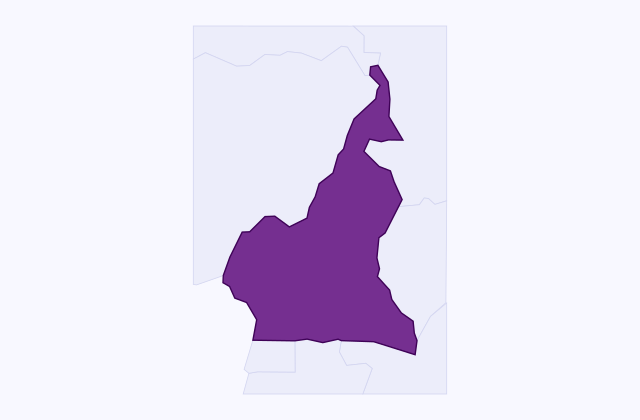
Cameroon's ties with the British world go back to the nineteenth century. English and Jamaican Baptist missionaries settled on the coast in the 1840s, and in 1858 Alfred Saker founded Victoria, today's Limbe, at the foot of Mount Cameroon. The Duala chiefs asked Britain more than once for its protection, but in July 1884 Germany raised its flag at Douala a few days before the British consul arrived, and Kamerun remained a German protectorate until British and French troops conquered it between 1914 and 1916. In 1919 the territory was divided: France took the larger part, and Britain two strips along the Nigerian border, later known as the Northern and Southern Cameroons, which it held under a League of Nations mandate and, from 1946, a United Nations trusteeship, and administered as part of Nigeria; the Southern Cameroons, governed from Buea, had its own assembly from the 1950s. French Cameroun became independent on 1 January 1960. In the United Nations plebiscites of February 1961 the Northern Cameroons voted to join Nigeria and the Southern Cameroons to join the Republic of Cameroon, which on 1 October 1961 became a federal republic of two states, East and West Cameroon; the referendum of 1972 replaced the federation with a unitary state, and Cameroon joined the Commonwealth in 1995. English and French are its two official languages, and the North-West and South-West regions, around Bamenda and Buea, remain the English-speaking part of the country, with an English-language school system leading to the GCE O and A Levels and a common-law tradition in the courts; since 2016 the two regions have been affected by a crisis that has displaced many people. Today a Cameroonian community lives in the UK — students, workers and families settled for a generation, many of them from these regions. British and Irish nationals work in Cameroon for companies, NGOs, churches, schools and development programmes, and British-Cameroonian couples live in both countries. That is why Cameroon has its page in the English version of this site.
Cameroon, about 29 million inhabitants, is a bilingual republic of ten regions whose law combines the French and British traditions. The Civil Code inherited from the colonial period applies in the French-speaking regions, while the North-West and South-West apply rules inspired by the common law to succession and to certain questions of personal status; recognised droits coutumiers (customary laws) have their own courts, and Ordinance No. 81-02 of 29 June 1981 on the état civil (civil status registration) applies throughout the country. Spouses marry before the officier d'état civil (civil status registrar). At the ceremony they choose between monogamy and polygamy and between community and separation of property, and both choices are written into the marriage certificate. A customary marriage has civil effect only once it is recorded in the état civil, and divorce is judicial. The draft Code des personnes et de la famille (Code of Persons and the Family) has been discussed for many years but has not been adopted. The Penal Code of 2016 punishes same-sex relations with six months to five years' imprisonment and a fine (article 347-1), a provision that leads to regular prosecutions, and prohibits abortion except after rape or where the mother's health is in serious danger (articles 337 to 339); Law No. 97-19 of 7 August 1997 punishes drug use as well as trafficking but provides treatment and rehabilitation for users. The pages below set out, topic by topic, what Cameroonian law provides, how things are done and where to go — and what matters for a British or Irish resident or couple: the GOV.UK 'marriage abroad' tool, the FCDO Legalisation Office and certified English translations of documents in French, the rule that nobody domiciled in the UK can validly enter into an actually polygamous marriage, recognition of a Cameroonian divorce under the Family Law Act 1986, land in Cameroon that follows Cameroonian rules even under an English will, adoption from a country that is not a party to the 1993 Hague Convention, which must start with approval in the UK, the FCDO travel advice, which advises against all travel to the North-West and to most of the South-West, and the British High Commission in Yaoundé, which carries out no notarial acts in a Commonwealth country, or, for Irish citizens, the Department of Foreign Affairs.