
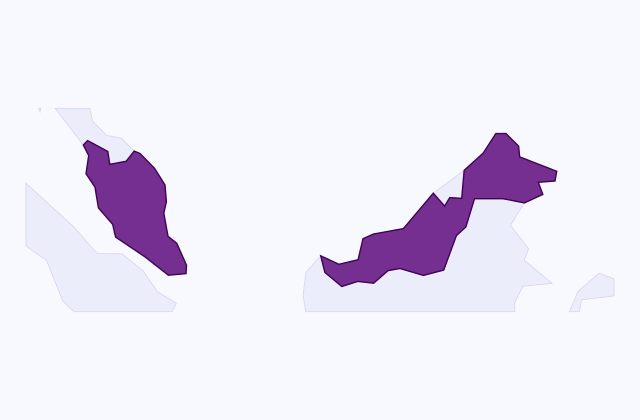
The legal framework
Federal penal provisions inherited from colonial law criminalise so-called carnal intercourse against the order of nature and gross indecency. In parallel, state religious enactments criminalise same-sex acts for Muslims, and these are enforced through the religious courts, including with caning in some states. There is no protection against discrimination, and public expression carries real risk.
Malaysia criminalises same-sex conduct twice over: under the federal penal code, which applies to everyone, and under state Syariah enactments, which apply to Muslims and cover a wider range of conduct including cross-dressing. Enforcement is real, with raids and prosecutions in Syariah courts. A Federal Court ruling in 2021 struck down one state provision on constitutional grounds, which was significant but narrow.
Key points
| Federal law | Colonial-era provisions criminalise same-sex acts |
|---|---|
| State religious law | Parallel offences for Muslims, enforced by religious courts |
| Penalties | Imprisonment, fines and, in some states, caning |
| Discrimination | No legal protection |
| Enforcement | Raids and prosecutions occur; risk is real rather than theoretical |
| Digital exposure | Applications and messages are commonly used as evidence |
| Health care | Accessible; testing services do not require disclosure |
In practice
- Dual jurisdiction means the applicable law depends on the state and on the person's religion.
- Do not keep material on your phone that could expose you; use locking and automatic deletion.
- Health and testing services remain accessible and do not require any declaration.
- If questioned, ask for a lawyer before answering and do not consent to a phone search.
Cost and coverage
Public health services are heavily subsidised; legal representation is costly, though some organisations assist without charge.
Recent changes
Enforcement by state religious departments has continued, including raids and prosecutions, while the 2021 Federal Court decision has prompted constitutional challenges to comparable provisions in other states.
Where to go
- Non-governmental health and testing services.
- Legal aid organisations with experience of these cases.
- Regional human rights organisations.
Worth knowing
The most common pathway to trouble is a phone: screenshots, application profiles and messages. Digital caution is the single most effective protective measure.
Frequently asked questions
How are the two systems different?
The federal penal code applies to all residents and criminalises certain acts. State Syariah enactments apply only to Muslims and are broader, covering conduct such as cross-dressing and attempts, enforced by state religious departments with their own officers and courts. A Muslim can face both.
What did the 2021 Federal Court decision do?
It struck down a Selangor Syariah provision on the ground that the state had legislated on a matter already covered by federal law, exceeding its constitutional powers. It was a jurisdictional ruling rather than one about rights, and it did not affect other states or the federal offence.
Official sources and links
- MyGovernment — official government portal