
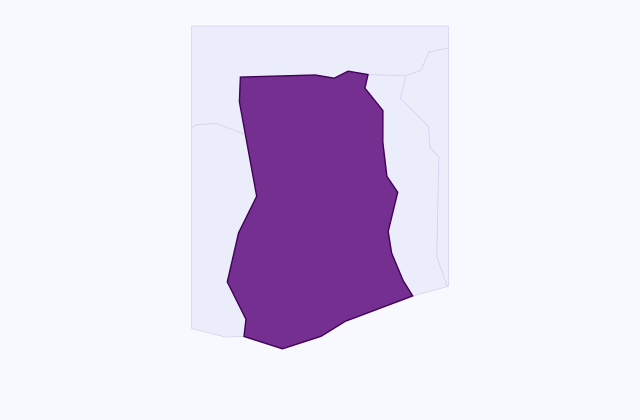
The legal framework
The criminal code criminalises unnatural carnal knowledge as a misdemeanour. A much broader bill, which would criminalise identifying as lesbian, gay, bisexual or transgender and the promotion or funding of related activity, has been passed by Parliament and awaits presidential assent; its final status has been contested and should be checked before relying on any summary. Extortion and family expulsion are the most common harms in practice.
Same-sex conduct is already an offence in Ghana as unnatural carnal knowledge, a misdemeanour. Beyond that sits a much broader bill: passed by Parliament in February 2024, it lapsed when Parliament was dissolved before the 2024 election, was reintroduced as a private member's bill in March 2025, and was passed again by Parliament on 29 May 2026. It provides for imprisonment for identifying as LGBTQ and longer sentences for promotion or support. As of mid-2026 it awaited presidential action, with the President saying it would first be examined by his legal advisers.
Key points
| Criminal law | Misdemeanour under the criminal code; a far broader bill has passed Parliament and awaits assent |
|---|---|
| Discrimination | No legal protection on grounds of sexual orientation |
| Marriage and unions | Not available |
| Organisations | Operate under legal and financial pressure, often through health programmes |
| Extortion | Common, usually arranged through dating applications |
| Health care | Testing and treatment remain accessible without disclosure |
| Travellers | The law applies to visitors and foreign residents |
In practice
- Do not keep messages, images or application profiles that could expose you.
- Treat meetings arranged online with strangers as high risk.
- Health and testing programmes continue and do not require any declaration.
- If arrested, ask for a lawyer and do not sign a statement you have not read.
Cost and coverage
Health services remain accessible at low cost; legal defence is expensive, though organisations sometimes fund it.
Recent changes
Parliament passed the Human Sexual Rights and Family Values Bill again on 29 May 2026 after it lapsed with the 2024 dissolution and was reintroduced in March 2025; presidential assent was still pending as of mid-2026.
Where to go
- Non-governmental health and testing programmes.
- Human rights organisations, including regional ones.
- Lawyers experienced in these prosecutions.
Worth knowing
Extortion and eviction are far more frequent than prosecution. Both usually start from a phone or a landlord, which is where practical precautions matter most.
Frequently asked questions
Is the broader bill law?
Not at the time of writing. Parliament passed it on 29 May 2026, and the President said in June 2026 that it would be examined by the attorney general and his legal advisers before any further step. Until it is assented to and gazetted, the existing misdemeanour provision is the operative law.
What practical precautions make sense?
Assume that anything written down can be read: dating profiles, messages, photographs, cloud backups. Meet new people in public, tell someone where you are going, and be cautious with anyone who moves quickly to demands for photographs or money — blackmail using images is the most common harm reported. Know which organisation you would contact before you need it, and keep the number somewhere other than your phone.
Official sources and links
- Ghana.gov — official government portal