
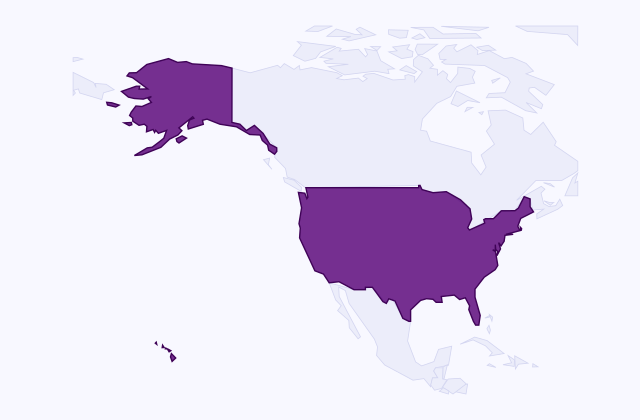
The legal framework
There is no federal entitlement to paid maternity leave. Federal law provides twelve weeks of unpaid, job-protected leave, and only to employees who meet its conditions — which excludes a substantial share of workers. A growing number of states run their own paid family leave programmes. Medicaid covers a large share of all births, and maternal mortality is the highest among comparable countries, with severe racial disparities.
The United States is the only high-income country with no national paid maternity leave. The federal Family and Medical Leave Act gives twelve weeks of unpaid, job-protected leave, and only to employees who meet its service and employer-size conditions — which excludes a large minority of workers. A growing number of states run their own paid family leave insurance schemes, so entitlements depend heavily on where you work.
Key points
| Paid leave | No federal entitlement; a growing number of states run their own programmes |
|---|---|
| Unpaid leave | Twelve weeks of job-protected leave under federal law, subject to conditions |
| Coverage | Medicaid covers a large share of all births; eligibility extends postpartum in most states |
| Cost | Substantial out-of-pocket costs even with insurance |
| Care model | Obstetrician-led; midwifery access varies sharply by state |
| Outcomes | The highest maternal mortality among high-income countries, with wide racial disparities |
| Postpartum coverage | Extended to twelve months after birth in most states |
In practice
- Check your state: paid family leave, Medicaid postpartum coverage and midwifery access all vary enormously.
- Ask for an itemised cost estimate in advance; hospitals must provide good-faith estimates.
- Doula support is covered by Medicaid in a growing number of states and improves outcomes.
- Know the warning signs of postpartum complications: most maternal deaths occur after the birth, not during it.
Cost and coverage
Costs depend entirely on coverage; Medicaid and community health centres exist precisely to close the gap.
Recent changes
More states have introduced paid family and medical leave insurance programmes, and federal law now requires reasonable accommodations for pregnant workers and protected break time and space for nursing employees.
Where to go
- State Medicaid offices and health department maternal programmes.
- Federally qualified health centres for low-cost prenatal care.
- State paid family leave programmes where they exist.
Worth knowing
More than half of pregnancy-related deaths in the United States occur after the birth, and most are judged preventable. Severe headache, heavy bleeding, chest pain or a fever in the weeks after delivery are emergencies.
Frequently asked questions
Is maternity leave paid in the United States?
Not federally. The Family and Medical Leave Act provides twelve weeks of unpaid leave with job protection, for eligible employees only. Around a dozen states and the District of Columbia run paid family leave insurance programmes, and many employers offer paid leave voluntarily.
What does maternity care cost?
With insurance, the out-of-pocket cost of a birth commonly runs into the low thousands of dollars after deductibles and co-insurance; without insurance it is far more. Check your plan's maternity coverage and the network status of the hospital and the anaesthetist early — surprise bills are common.
Official sources and links
- USA.gov — official guide to government services
- Congress.gov — federal legislation