
The legal framework
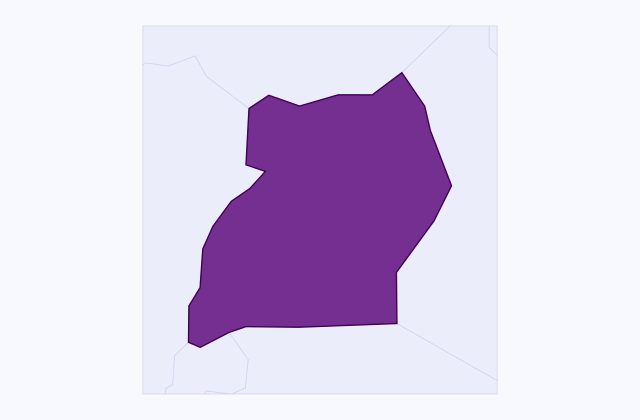
The Prohibition of Female Genital Mutilation Act 2010 created a comprehensive offence, including aggravated FGM carrying life imprisonment, and made failure to report an offence. National prevalence is very low, but the practice persists among the Sabiny in the east and the Pokot in the north-east, where girls are sometimes taken across the border into Kenya to be cut.
Uganda prohibited the practice in 2010 with a dedicated Act, and the Constitutional Court has upheld it against a cultural-rights challenge. Prevalence is confined to two communities in the east and north-east. The recurring difficulty is the same as in Kenya: girls taken across the border for the procedure, and ceremonies moved to remote locations or carried out on younger children to avoid detection.
Key points
| Statute | Prohibition of Female Genital Mutilation Act 2010 |
|---|---|
| Aggravated FGM | Carries life imprisonment where death results or the victim is disabled |
| Failure to report | An offence |
| Prevalence | Very low nationally, concentrated among the Sabiny and Pokot |
| Cross-border | Girls are sometimes taken into Kenya to avoid the law |
| Alternative rites | Community programmes replace cutting with other ceremonies |
| Care | Available in regional referral hospitals |
In practice
- Report to the police child and family protection unit or to the district community development officer.
- Where travel across the border is planned, report it: joint operations exist with Kenyan authorities.
- Alternative rite of passage programmes allow families to keep the ceremony without the cutting.
- Tell the midwife at the first antenatal visit.
Cost and coverage
Reporting and public health care are free or low cost.
Where to go
- Police child and family protection units.
- District community development officers.
- Regional referral hospitals.
Worth knowing
Cross-border cutting between Uganda and Kenya is the central enforcement problem. Both countries' laws follow residence, so the journey does not put anyone beyond reach.
Frequently asked questions
What penalties does the 2010 Act set?
Imprisonment for the offence, with a higher penalty — up to life — for aggravated cases, including where the victim dies, is disabled or is infected with HIV. Attempting, aiding or failing to report are also offences.
Has the law been challenged?
Yes, on cultural-rights grounds, and the Constitutional Court upheld it, holding that the practice cannot be justified as culture where it violates the right to health and dignity. That judgment is regularly cited across the region.
Official sources and links
- World Health Organization — international reference on this topic
- WHO Regional Office for Africa — country data and programmes