
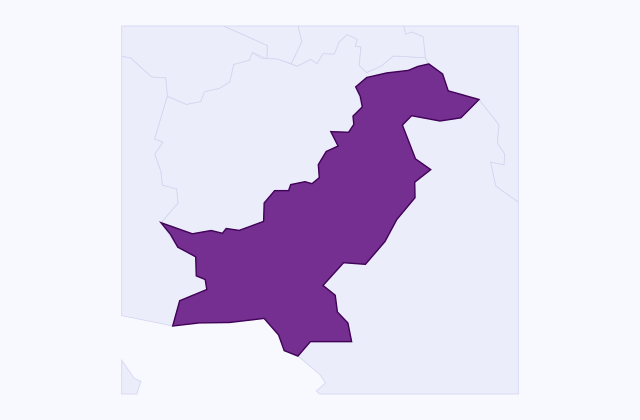
The legal framework
Contraception is legal and supplied free or at low cost through government health facilities, Lady Health Workers and family planning NGOs. Contraceptive prevalence remains low, and unmet need high, for reasons including stock-outs, distance, provider bias and social pressure rather than legal barriers.
Key points
| Cost | Free or subsidised in the public sector |
|---|---|
| Lady Health Workers | Deliver counselling and supplies at household level — the backbone of rural provision |
| Methods | Condoms, pills, injectables, IUDs, implants and sterilisation |
| Emergency contraception | Available in pharmacies in major cities |
| Consent | No legal requirement for a husband's consent, though it is often demanded in practice |
| NGO providers | Rahnuma-FPAP, Greenstar and Marie Stopes operate extensive networks |
| Postpartum | Family planning counselling integrated into maternity services |
| Public provision | Free through government facilities and the Lady Health Worker programme |
| Home delivery | Lady Health Workers supply contraceptives at home in many districts |
| Unmet need | Officially recognised as high, and a policy priority |
In practice
- Ask about long-acting methods — implants and IUDs are the most effective and often the cheapest over time.
- Check contraindications: smoking over 35, migraine with aura and a history of clots rule out combined methods.
- Keep emergency contraception at home; the sooner it is taken, the better it works.
- Only condoms also protect against sexually transmitted infections.
- Ask the Lady Health Worker for your area: she can supply discreetly and without a clinic visit.
- NGO clinics offer long-acting methods at low cost where public facilities are stretched.
Cost and coverage
Free in public facilities; low-cost through social marketing networks.
Recent changes
Provincial governments have committed to expanding method choice and reducing stock-outs, with postpartum family planning a particular focus.
Where to go
- Lady Health Workers and basic health units.
- Rahnuma — Family Planning Association of Pakistan.
- Greenstar and Marie Stopes Society clinics.
Worth knowing
Spousal consent is not a legal requirement. NGO clinics are generally the most reliable route if you want a method without that conversation. There is no legal requirement for a husband's consent. Facilities may ask; that practice has no basis in law.
Official sources and links
- Government of Pakistan — official government portal