
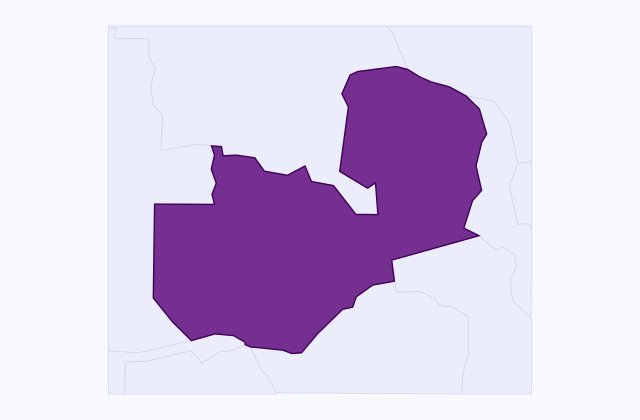
The legal framework
There is no Zambian legislation on assisted reproduction. Clinics operate under the Health Professions Council of Zambia and general facility licensing. A small number of private providers in Lusaka offer investigation, ovulation induction and insemination, with IVF available on a limited basis. Most patients requiring IVF travel to South Africa, where costs are lower than in Europe and the regulatory framework is clear.
Doing the diagnosis at home and the treatment abroad is the rational strategy for Zambian couples. The work-up is inexpensive locally, and arriving in Johannesburg with a complete file shortens the stay and cuts the cost materially.
A significant share of infertility in Zambia follows pelvic infection, including untreated sexually transmitted infections. Prevention and prompt treatment of infections remain the most effective fertility policy available.
HIV prevalence makes serodiscordant conception a common question. Modern practice is clear: with sustained undetectable viral load there is no sexual transmission, and where assisted conception is needed, sperm washing is available in the referral centres.
Same-sex couples: assisted reproduction is offered privately to heterosexual couples.
Key points
| Law | No ART statute |
|---|---|
| Regulation | Health Professions Council of Zambia; general facility licensing |
| Offer | Investigation and insemination in Lusaka; limited IVF |
| Referral | South Africa is the usual destination for IVF |
| Funding | None |
| Donation | Not organised locally |
In practice
- Complete the diagnostic work-up in Lusaka: semen analysis, hormone profile, pelvic ultrasound, tubal assessment.
- Treat infection and ovulation disorders locally, which resolves a meaningful proportion of cases.
- If IVF is indicated, obtain quotations from South African centres and compare total cost including travel.
- Prepare a complete, recent medical file so the receiving centre does not repeat everything.
- Plan a stay of two to three weeks for a full cycle abroad.
Cost and coverage
The work-up in Lusaka costs a few thousand kwacha. An IVF cycle in South Africa costs R 50,000 to R 90,000 including medication, to which travel and two to three weeks' accommodation must be added. Nothing is covered by public funding.
Recent changes
Interest in developing domestic capacity has grown, but the limiting factor is the same as elsewhere in the region: trained embryologists and a laboratory with enough throughput to maintain quality.
Where to go
- Private clinics and laboratories in Lusaka, for investigation and first-line treatment
- University Teaching Hospital, Lusaka, for specialist gynaecology
- Health Professions Council of Zambia, for practitioner registration
- Fertility centres in Johannesburg, Pretoria and Cape Town, commonly used
- Zambia Medical Association, for referrals
Worth knowing
Quotations from foreign centres often exclude medication, which can be a third of the cost: ask for an all-inclusive figure before booking travel.
Frequently asked questions
Can I have IVF in Zambia?
Capacity is limited. Investigation and insemination are available in Lusaka; most patients travel to South Africa for IVF.
What does it cost?
R 50,000 to R 90,000 for a cycle in South Africa including medication, plus travel and two to three weeks' accommodation.
What should I do first?
The full couple work-up in Lusaka, which is inexpensive and identifies treatable causes.
Is there a law on assisted reproduction?
No. Practice is governed by general health facility and practitioner regulation.
How long is a stay abroad?
Around two to three weeks for a complete cycle, including monitoring, collection and transfer.
Official sources and links
- UN Human Rights Office — ratified treaties and country reviews
- ILO NATLEX — national legislation database