
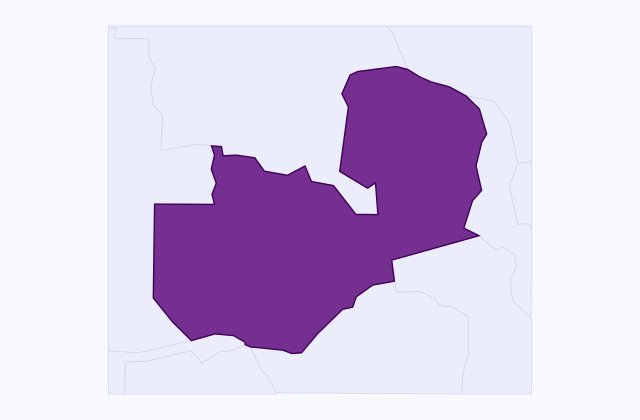
The legal framework
The Termination of Pregnancy Act 1972 is unusually permissive for the region: abortion is lawful where continuing the pregnancy would risk the life or the physical or mental health of the woman or her existing children, taking account of her actual or reasonably foreseeable environment — which includes socio-economic grounds. Three medical practitioners must normally agree. The three-doctor requirement is the principal practical barrier, particularly outside Lusaka.
Key points
| Legal basis | Penal legislation, read together with the Constitution and national clinical guidelines |
|---|---|
| Post-abortion care | Part of essential health services; must be provided without conditions |
| Contraception | Legal and provided through national family planning programmes |
| Practical barrier | Uncertainty among providers about the scope of the legal exception |
| Maputo Protocol | Ratified, requiring lawful abortion in cases of assault, incest, risk to health and serious fetal abnormality |
| Young people | Adolescent access is a recognised gap in national strategies |
| Termination of Pregnancy Act 1972 | Comparatively permissive, including socio-economic grounds |
| Three doctors | The Act requires three registered practitioners, which is impossible in most districts |
| Penal Code conflict | The Penal Code still criminalises abortion, creating uncertainty |
| Standards | Ministry guidelines allow a single provider in specified circumstances |
In practice
- Go to a public health facility for assessment; district hospitals handle emergency obstetric care.
- Seek urgent care for heavy bleeding, fever or severe pain — delay, not the law, is what causes deaths.
- Family planning associations affiliated to IPPF are the most accessible source of accurate local information.
- Keep written records of any assessment: they matter if a referral becomes necessary.
- Ask at a district hospital about the ministry guidelines, which are more workable than the Act's wording.
- Post-abortion care is available at public facilities and is not conditional on a report.
Cost and coverage
Public facilities provide care free or at low cost; NGO providers charge modest fees.
Recent changes
Across the region, the trend is towards clarifying clinical guidelines rather than amending criminal law, so what changes in practice is provider guidance, not the statute.
Where to go
- District and referral hospitals for emergency obstetric and post-abortion care.
- National family planning association (IPPF affiliate).
- Ministry of health reproductive health programmes.
Worth knowing
Health workers are bound by confidentiality, and in most of these countries there is no duty to report a patient who seeks post-abortion care. Fear of prosecution should not keep you from a hospital. The three-doctor requirement is the reason a relatively liberal law produces very little legal provision. Ministry guidance, not the Act, is what makes access possible in practice.
Official sources and links
- World Health Organization — international reference on this topic
- WHO Regional Office for Africa — country data and programmes