
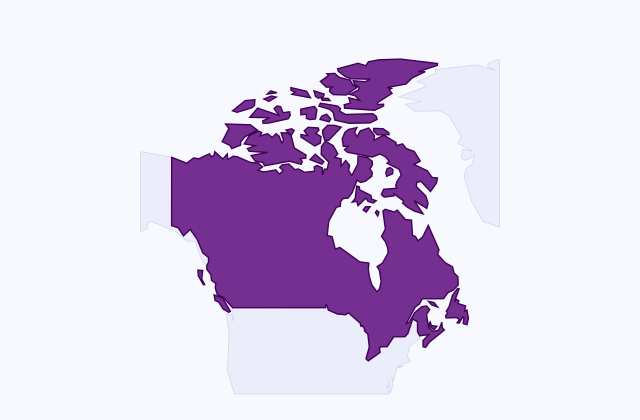
The legal framework
In R. v. Morgentaler (1988) the Supreme Court struck down the Criminal Code provisions as contrary to the Charter, and nothing replaced them. Abortion is regulated only by medical standards and by provincial health systems. Canada is one of very few countries with no abortion-specific criminal statute.
Key points
| Legal limit | None in law; clinical limits apply, typically around 23 to 24 weeks, with later care available in a few centres |
|---|---|
| Consent | No spousal or parental consent required |
| Medication abortion | Mifegymiso prescribed in primary care, including by nurse practitioners, and free in most provinces |
| Funding | Covered by provincial health insurance for residents |
| Access gaps | Distance is the real barrier in the territories, rural areas and parts of the Atlantic provinces |
| Safe access zones | In force in several provinces |
| No criminal law | Struck down in 1988; there has been no abortion offence since |
| No statutory limit | Limits are set by clinical practice and provider availability, not by legislation |
| Mifegymiso | Free in most provinces and prescribable by family doctors and nurse practitioners |
| Geography | Access is concentrated in cities; some provinces have very few providers |
In practice
- Self-refer to a clinic, a hospital or a family doctor — no referral needed in most provinces.
- Telehealth services provide medication abortion across large distances.
- Travel support programmes exist in some provinces for people who must go far.
- Ask explicitly about later gestational options if you are near the local clinical limit.
- Ask about medication abortion by telehealth if you live far from a clinic — it is widely available.
- Provincial health lines can confirm the nearest provider without a referral.
Cost and coverage
Covered by provincial insurance. People without provincial coverage — students, newcomers, undocumented residents — should ask about sliding-scale clinics.
Recent changes
The policy debate in Canada is about access and geography rather than legality: the number of service points, wait times and out-of-pocket travel costs.
Where to go
- Action Canada for Sexual Health and Rights — access line and clinic directory.
- Provincial health lines (811 in several provinces).
- Telehealth abortion services covering rural and remote areas.
Worth knowing
No legal limit does not mean unlimited access: clinical limits and waiting times mean it is worth calling immediately rather than waiting for a family doctor's appointment. The absence of a law does not mean unlimited access: after the early weeks, the practical constraint is how far you must travel.
Official sources and links
- Canada.ca — official government portal
- Justice Laws Website — federal statutes and regulations