
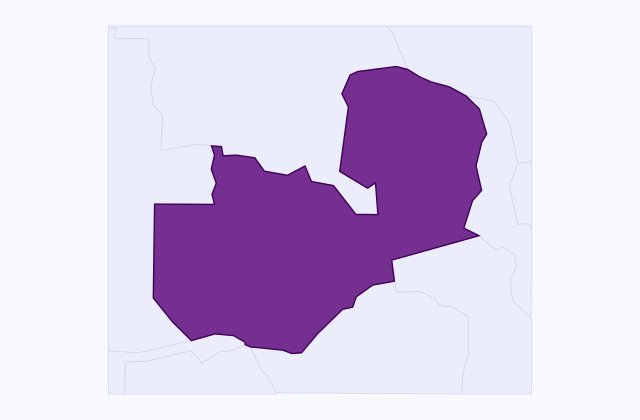
The legal framework
A step-parent acquires no parental rights by marriage. Children's legislation governs adoption, and guardianship is available through the courts. In practice, informal fostering within the extended family is common and rests on family arrangement rather than legal act, which leaves the child exposed if the parent dies or the couple separates. A stepchild does not inherit on intestacy, so a will is the only reliable protection.
Zambian law provides for adoption under the Adoption Act and for guardianship through the courts, with the Children's Code Act of 2022 consolidating child law and strengthening the best-interests principle. As across the region, most children not living with a parent are cared for by relatives without any legal step, which works until a document is needed — a passport, a school transfer, an inheritance claim.
Key points
| Step-parent status | No automatic parental rights |
|---|---|
| Adoption | Available with court oversight and consent |
| Guardianship | Often faster than adoption and widely used |
| Intestacy | A stepchild does not inherit |
| Informal fostering | Common, but carries no legal effect |
| Birth registration | Determines what is legally possible |
| School and medical | Written authority from the parent is needed |
In practice
- Register the child's birth: without a certificate, no process can begin.
- Informal fostering has no legal effect - formalise it if you want it to hold.
- Make a will: a stepchild inherits nothing otherwise.
- A guardianship order is usually quicker than adoption.
Cost and coverage
Court fees for guardianship or adoption are modest; legal representation is the main cost, and proceedings commonly take several months. Legal aid or a legal aid clinic can cover the fees for families with low income.
Recent changes
The Children's Code Act of 2022 consolidated child law into a single statute and strengthened the best-interests principle across custody, guardianship and adoption proceedings.
Where to go
- Children's or family court, for adoption and guardianship.
- Social welfare department.
- Legal aid services and community legal clinics.
Worth knowing
Informal fostering collapses precisely when it is most needed - on the death of the parent. A short written instrument changes that outcome.
Frequently asked questions
What did the Children's Code Act change?
It consolidated fragmented child legislation into a single statute, strengthened the best-interests standard, and clarified care arrangements including guardianship and foster care. It also aligned Zambian law more closely with the regional and international instruments the country has ratified.
Can a step-parent adopt?
Yes, under the Adoption Act, subject to residence requirements, a period during which the child has lived with the applicant, and the consent of the parents or its dispensation. The court considers whether adoption or a lesser order best serves the child.
Official sources and links
- UN Human Rights Office — ratified treaties and country reviews
- ILO NATLEX — national legislation database