
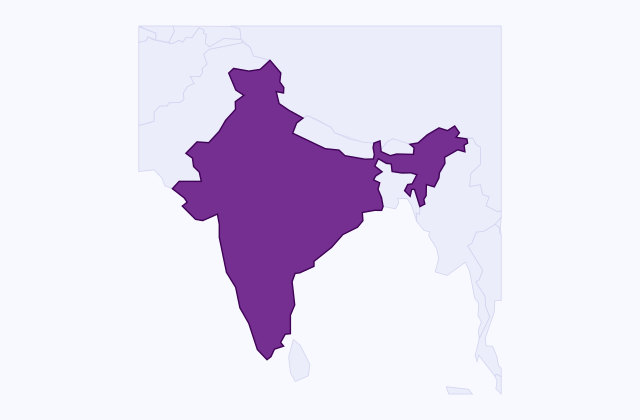
The legal framework
There is no general statute conferring rights on a step-parent. Adoption of a spouse's child is available under Hindu personal law, and guardianship under the general guardianship statute applies to everyone. For Muslim families, adoption in the sense of full filiation is not recognised, though guardianship is available and the juvenile justice legislation offers a secular adoption route open to all communities. Stepchildren do not inherit under intestate succession.
There is no single answer in India, because family law depends on the personal law that applies to the family. Adoption under the Hindu Adoptions and Maintenance Act is available to Hindus, Buddhists, Jains and Sikhs; Muslims, Christians and Parsis historically could not adopt under their personal law and instead use guardianship under the Guardians and Wards Act, or the secular Juvenile Justice Act, which now provides a route open to everyone.
Key points
| Adoption | Available under Hindu personal law; a secular route exists under juvenile justice legislation |
|---|---|
| Guardianship | Available to all under the general guardianship statute |
| Muslim personal law | Does not recognise adoption as filiation; guardianship applies instead |
| Intestate succession | Stepchildren do not inherit |
| Maintenance | No obligation on the step-parent |
| School and medical | Written authority from the parent is needed in practice |
| Documents | Birth registration determines what is possible |
In practice
- A will is the only reliable way to provide for a stepchild.
- Guardianship under the general statute is open regardless of religion.
- Written authority from the parent avoids most school and hospital difficulties.
- Check which personal law applies before starting any adoption process.
Cost and coverage
Court fees are low; the cost is in legal representation and in the time a guardianship or adoption petition takes, frequently a year or more. District courts vary considerably in speed.
Recent changes
Adoption under the Juvenile Justice Act has been moved partly to district magistrates to speed up proceedings, and the central adoption authority has tightened procedures for relative and step-parent adoptions.
Where to go
- District court, for guardianship and adoption.
- Legal aid services and law school clinics.
- Child welfare committees, for the secular adoption route.
Worth knowing
The route that works depends on the family's personal law, and the two systems do not lead to the same result. Take advice before starting, not after.
Frequently asked questions
Can anyone adopt a step-child in India?
Under the Hindu Adoptions and Maintenance Act, Hindus, Buddhists, Jains and Sikhs can. Others historically could not adopt so as to create filiation, and used guardianship instead. The Juvenile Justice Act now provides a secular adoption route available regardless of religion, and it is increasingly used.
What does guardianship give a step-parent?
Authority over the child's person and property under a court order, without creating a parent-child relationship for inheritance. It ends when the child reaches majority. For many families it is the only available route, and it needs to be paired with a will if inheritance matters.
Official sources and links
- India.gov.in — national portal of India
- India Code — central and state legislation