
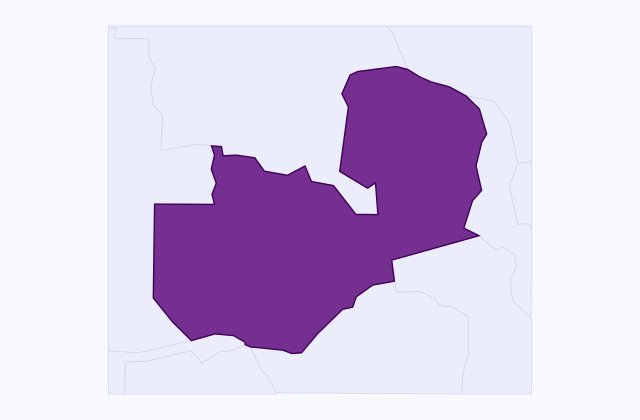
The legal framework
Divorce is governed by the Matrimonial Causes Act 2007, under which the sole ground is irretrievable breakdown. Customary marriages are dissolved in local courts, and the two systems coexist with different property consequences.
Key points
| Ground | Irretrievable breakdown, established by statutory facts |
|---|---|
| One-year bar | No petition within the first year of marriage |
| Property | Settlement of property and maintenance available under the Act |
| Customary divorce | Local courts, applying customary law |
| Children | Welfare principle applies |
| Matrimonial Causes Act 2007 | Irretrievable breakdown as the sole ground |
| Local courts | Customary marriages are dissolved in the local courts |
In practice
- File in the High Court or family division with jurisdiction over your marriage type.
- Financial disclosure is essential: property outcomes turn on documented contributions.
- Where the marriage was customary or religious, check first whether it was registered — registration determines which court can dissolve it.
- Mediation and family counselling are available and often faster than contested litigation.
- Establish first whether your marriage was statutory or customary: the forum depends on it.
- Keep receipts and records of contributions to any property.
Cost and coverage
Court fees are moderate; legal aid and law school clinics assist those who cannot pay.
Recent changes
Across these jurisdictions the clearest trend is judicial recognition of non-financial contribution — domestic work and childcare — when dividing property.
Where to go
- High Court family division or equivalent.
- Legal aid schemes and university law clinics.
- Women's rights organisations, which often provide representation in property disputes.
Worth knowing
An unregistered customary or religious marriage can be very hard to dissolve, and even harder to found a property claim on. Registration is the step that converts a social fact into enforceable rights. Local courts handle customary divorces quickly and cheaply, but their property awards are often minimal. Take advice before choosing that route if there are significant assets.
Official sources and links
- UN Human Rights Office — ratified treaties and country reviews
- ILO NATLEX — national legislation database