
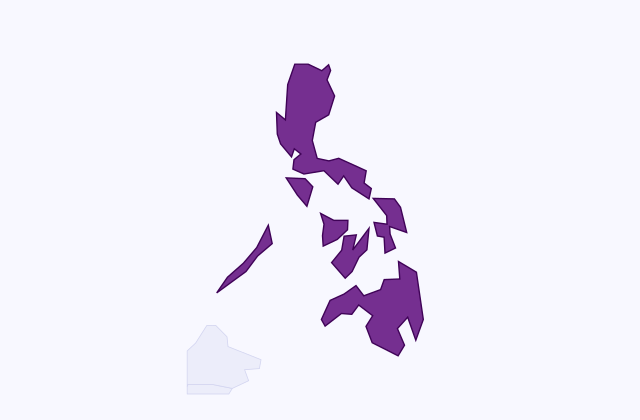
The legal framework
The framework rests on the Cybercrime Prevention Act 2012, under which cyberlibel carries heavier penalties than print libel and a long prescriptive period, alongside the Anti-Photo and Video Voyeurism Act. The Safe Spaces Act 2019 also covers gender-based online sexual harassment, with administrative and criminal penalties.
Key points
| Defamation | Civil in all of these jurisdictions; criminal defamation retained in some |
|---|---|
| Cyberharassment | Criminalised by cybercrime legislation |
| Intimate images | Non-consensual distribution is an offence |
| Platform removal | Usually faster than any legal route; use it first |
| Risk to speakers | Cybercrime provisions have been used against journalists and critics in several of these countries |
| Evidence | Screenshots with URL and date are the foundation of any complaint |
| Cyber libel | Libel committed online carries a higher penalty than in print |
| Prescription | The period for cyber libel has been the subject of conflicting rulings |
| Safe Spaces Act | Covers gender-based online sexual harassment |
| Civil damages | Can be claimed alongside the criminal case |
In practice
- Capture evidence first: full screenshots with URL, date and surrounding context, before anything is deleted.
- Report to the platform and keep the reference number and the outcome.
- Then use the legal route — the order matters, because platforms act faster than courts.
- Do not respond in kind: your own posts become evidence too.
- File with the prosecutor's office with printed copies and certified screenshots.
- Consider a civil claim in parallel; it is not dependent on a conviction.
Cost and coverage
Police complaints are free; civil defamation actions are expensive.
Recent changes
Regional courts — including the ECOWAS Court and the African Court — have pressed for the decriminalisation of defamation, and several countries in the region have moved in that direction.
Where to go
- PNP Anti-Cybercrime Group and NBI Cybercrime Division.
- Philippine Commission on Women for Safe Spaces Act complaints.
- National Privacy Commission where personal data is involved.
Worth knowing
Two habits protect you in these jurisdictions: document what you receive, and think twice about what you post. Cybercrime provisions are used in both directions, and an angry reply can turn a complainant into a defendant. Criminal libel remains in force and cyber libel carries a heavier penalty. That makes online criticism legally riskier here than in most common law countries.
Official sources and links
- gov.ph — official government portal