
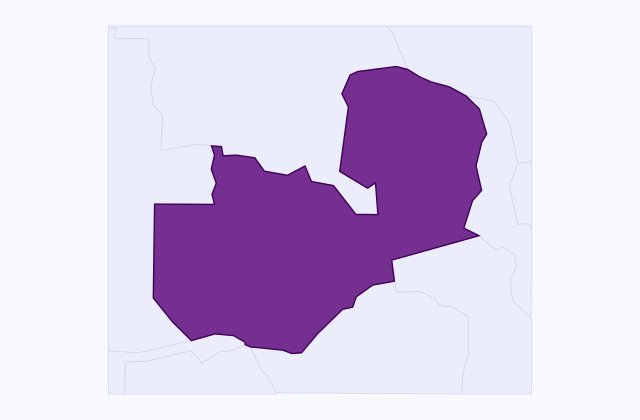
The legal framework
The Copyright and Performance Rights Act protects literary, musical and artistic works for the author's life plus fifty years. Administration falls to the Registrar of Copyright within the responsible ministry, and collective management is handled by licensed societies. Fair dealing exceptions cover research, private study, criticism, review and news reporting.
Zambia's Copyright and Performance Rights Act protects works for the author's life plus fifty years and provides for a registration system and for collecting societies to administer music and performance rights. Enforcement action tends to focus on physical piracy and on public performance licensing; online infringement is harder to pursue and the practical remedy is usually a takedown request to the platform.
Key points
| Statute | Copyright and Performance Rights Act |
|---|---|
| Term | Life plus 50 years |
| Administration | Registrar of Copyright |
| Collective management | Licensed societies for music and performance rights |
| Fair dealing | Research, private study, criticism, review, reporting |
| Enforcement | Registrar's office and the High Court |
| Registrar of Copyright | Administers the system within the responsible ministry |
| Criminal enforcement | Available for commercial-scale infringement |
In practice
- Assume everything you find online is protected: absence of a copyright notice means nothing.
- Look for an explicit licence — Creative Commons, a stock licence, a written permission — and keep a copy of it.
- Credit alone is not a defence: attribution does not replace permission.
- For anything commercial, get permission in writing and keep it for as long as you use the work.
- Keep dated drafts and file metadata: there is no registration certificate to rely on.
Where to go
- Registrar of Copyright.
- Zambia Music Copyright Protection Society.
- High Court commercial list.
Worth knowing
Keep dated evidence of creation — drafts, files with metadata, correspondence — because there is no registration certificate to fall back on. With no registration system, contemporaneous evidence of creation is the only proof of authorship available.
Frequently asked questions
Do you need to register a work in Zambia?
No. Protection arises automatically on creation, as in every country party to the Berne Convention. Registration with the copyright office is optional but provides useful evidence of authorship and date, which matters if ownership is ever disputed.
Who owns a photograph of the two of us?
Copyright belongs to whoever pressed the shutter, not to the people in the picture — so a photograph taken by a friend or a wedding photographer is theirs unless the contract says otherwise. Being in the image gives you a separate claim based on privacy or personality rather than copyright. If you want to use wedding photographs freely, negotiate a licence in writing before the day, not afterwards.
Official sources and links
- UN Human Rights Office — ratified treaties and country reviews
- ILO NATLEX — national legislation database