
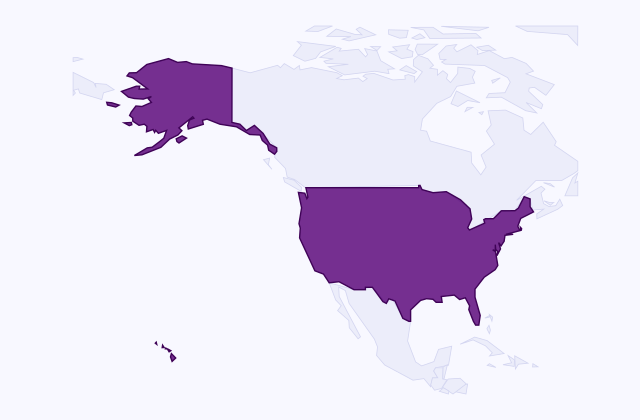
The legal framework
American copyright runs for the author's life plus seventy years, or ninety-five years from publication for works made for hire. Its distinctive feature is fair use: an open-ended balancing of four factors — purpose, nature of the work, amount used, and effect on the market. Registration with the Copyright Office is not required for protection, but it is required before suing and before statutory damages and attorney's fees become available.
Key points
| Term | Life plus 70 years; 95 years from publication for works made for hire |
|---|---|
| Fair use | Four-factor balancing test, decided case by case |
| Registration | Required before filing suit; timely registration unlocks statutory damages |
| Statutory damages | Available without proving actual loss, where registration was timely |
| DMCA | Notice and takedown, with a counter-notice procedure |
| Small claims | The Copyright Claims Board hears low-value disputes without a lawyer |
| Attorney's fees | Recoverable, which changes the economics of litigation |
| Transformative use | A central concept in fair use, narrowed by recent Supreme Court authority |
In practice
- Assume everything you find online is protected: absence of a copyright notice means nothing.
- Look for an explicit licence — Creative Commons, a stock licence, a written permission — and keep a copy of it.
- Credit alone is not a defence: attribution does not replace permission.
- For anything commercial, get permission in writing and keep it for as long as you use the work.
- Register works within three months of publication to preserve statutory damages.
Recent changes
The Copyright Claims Board gives individual creators a low-cost forum for claims below the statutory ceiling, without needing a lawyer.
Where to go
- United States Copyright Office.
- Copyright Claims Board for small claims.
- Volunteer Lawyers for the Arts chapters.
Worth knowing
Register before infringement happens, not after. Late registration usually limits you to actual damages, which are often too small to justify litigation. The three-month registration window is what makes litigation viable. Registering after an infringement usually limits you to actual damages.
Official sources and links
- USA.gov — official guide to government services
- Congress.gov — federal legislation