
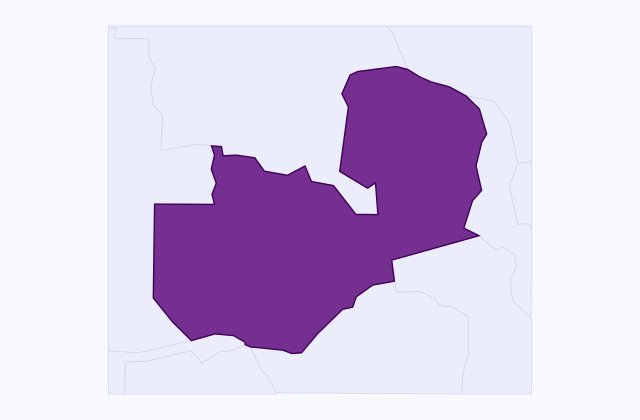
The legal framework
Zambia has no cohabitation regime; customary marriage, which is widely used and can be converted into a statutory marriage, is the recognised route to spousal rights. Property claims between cohabitants rest on proof of contribution.
Key points
| Status | Recognised by statute in some of these jurisdictions, not in others |
|---|---|
| Property | Claims generally rest on proving financial or non-financial contribution |
| Maintenance | Available only where a statute provides for it |
| Inheritance | A partner rarely inherits without a will, unless legislation says otherwise |
| Children | Their rights depend on parentage, not on the parents' marital status |
| Registration of customary marriage | Often the simplest way to convert a de facto union into recognised rights |
| No cohabitation statute | Only statutory and customary marriages are recognised |
| Customary marriage | Valid once the customary requirements, including lobola, are met |
| Affidavit of marriage | Commonly required to claim a pension or an estate |
| Property grabbing | A criminal offence, though enforcement is uneven |
In practice
- Keep documentary proof of every contribution to property — receipts, transfers, building materials.
- Register a customary marriage where that route is available; it is usually the cheapest protection.
- Make a will, and keep a copy with a trusted third party.
- Ensure children are registered and filiation acknowledged.
- Prepare an affidavit of customary marriage while both partners are alive.
- Report property grabbing to the police immediately: it is an offence, not a family matter.
Cost and coverage
Registration and wills are inexpensive; litigating a contribution claim is not.
Recent changes
The clearest regional trend is judicial recognition of non-financial contribution, alongside statutory protection for long cohabitation in parts of the Caribbean.
Where to go
- Civil registry for marriage registration.
- Legal aid schemes, law clinics and women's rights organisations.
- Local courts for maintenance and property claims.
Worth knowing
A surviving partner without a marriage certificate or a will is in the weakest position of anyone in these systems — often facing the deceased's family with nothing in writing. Fix that while both partners are alive. An affidavit prepared during the marriage prevents most of the disputes that arise when a spouse dies and relatives dispute the relationship.
Official sources and links
- UN Human Rights Office — ratified treaties and country reviews
- ILO NATLEX — national legislation database