
The legal framework
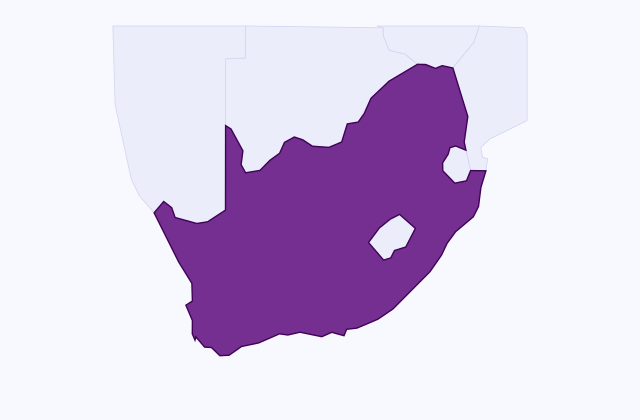
South Africa has no general cohabitation statute, but the courts have closed the worst gaps. In Bwanya (2021) the Constitutional Court held that a surviving life partner may inherit on intestacy and claim maintenance from the estate. A domestic partnership bill has been pending for years. Universal partnership claims and cohabitation agreements are the main practical tools.
Key points
| Status | Recognised by statute in some of these jurisdictions, not in others |
|---|---|
| Property | Claims generally rest on proving financial or non-financial contribution |
| Maintenance | Available only where a statute provides for it |
| Inheritance | A partner rarely inherits without a will, unless legislation says otherwise |
| Children | Their rights depend on parentage, not on the parents' marital status |
| Registration of customary marriage | Often the simplest way to convert a de facto union into recognised rights |
| No general statute | Life partnerships are not regulated by a single law |
| Court-made rights | The Constitutional Court has extended intestate succession and maintenance to permanent life partners |
| Cohabitation agreement | Enforceable and strongly advised |
| Universal partnership | Can be proved to claim a share of assets, but requires evidence |
In practice
- Keep documentary proof of every contribution to property — receipts, transfers, building materials.
- Register a customary marriage where that route is available; it is usually the cheapest protection.
- Make a will, and keep a copy with a trusted third party.
- Ensure children are registered and filiation acknowledged.
- Put a cohabitation agreement in writing, covering property, contributions and separation.
- Keep evidence of joint contribution to any asset — a universal partnership claim depends on it.
Cost and coverage
Registration and wills are inexpensive; litigating a contribution claim is not.
Recent changes
The clearest regional trend is judicial recognition of non-financial contribution, alongside statutory protection for long cohabitation in parts of the Caribbean.
Where to go
- Civil registry for marriage registration.
- Legal aid schemes, law clinics and women's rights organisations.
- Local courts for maintenance and property claims.
Worth knowing
A surviving partner without a marriage certificate or a will is in the weakest position of anyone in these systems — often facing the deceased's family with nothing in writing. Fix that while both partners are alive. Rights for life partners have come from constitutional litigation rather than legislation, so they are patchy. An agreement remains the only reliable protection.
Official sources and links
- gov.za — official government portal
- South African Human Rights Commission — constitutional rights body