
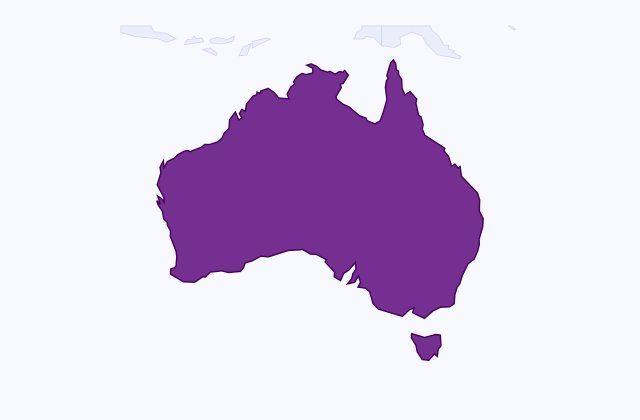
The legal framework
The Marriage Act 1961 was amended in December 2017, after a national postal survey, to define marriage as the union of two people. The minimum age is 18, with a court able to authorise a person aged 16 or 17 to marry an adult in exceptional circumstances — an exception used extremely rarely.
Key points
| Age | 18; court authorisation possible at 16 or 17 in exceptional circumstances |
|---|---|
| Polygamy | Prohibited; bigamy is an offence, though a foreign polygamous marriage may be recognised for limited family law purposes. |
| Notice | Notice of Intended Marriage at least one month and up to 18 months before |
| Same-sex marriage | Since 9 December 2017 |
| Celebrants | Commonwealth-registered civil celebrants and recognised religious ministers |
| Witnesses | Two, aged 18 or over |
| Overseas marriages | Recognised if valid where celebrated, subject to Australian rules on age and prohibited relationships |
| Forced marriage | A criminal offence under Commonwealth law |
| One month's notice | Notice of Intended Marriage, lodged between one and eighteen months before |
| Prescribed words | Certain words must be spoken; omitting them can invalidate the marriage |
| Authorised celebrants | A public register is maintained by the Attorney-General's Department |
| Minimum age 18 | With a narrow court exception at 16, used rarely |
In practice
- Lodge the Notice of Intended Marriage with your celebrant at least a month ahead.
- Produce birth certificates or passports and evidence of the end of any previous marriage.
- The celebrant registers the marriage with the state registry; order the certificate separately.
- Binding financial agreements — prenuptial equivalents — require independent legal advice for each party.
- Lodge the notice early; the one-month minimum is strict and rarely shortened.
- Check the celebrant on the public register before paying a deposit.
Cost and coverage
Celebrant fees vary widely; registry office ceremonies are the cheapest option.
Recent changes
Australia does not recognise overseas marriages of people under 18 where they would not be valid locally, which was tightened as part of the forced marriage reforms.
Where to go
- State and territory births, deaths and marriages registries.
- Attorney-General's Department register of marriage celebrants.
- My Blue Sky, the national forced marriage support service.
Worth knowing
De facto relationships in Australia carry property consequences very similar to marriage after two years. Choosing not to marry does not mean choosing not to be financially entangled. The celebrant must be on the national register. A ceremony conducted by a family member or an unregistered minister creates no legal marriage.
Official sources and links
- Federal Register of Legislation — Commonwealth law as made and in force
- Services Australia — government services and payments