
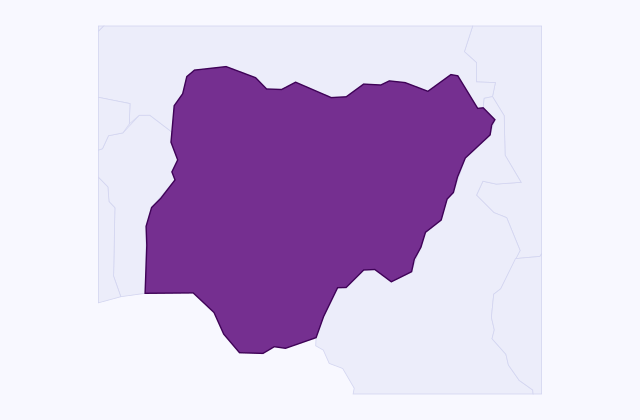
The legal framework
Nigerian policy provides for early child care and development education, with a one-year pre-primary class attached to public primary schools, but coverage is uneven and quality varies. In practice urban families use private crèches and nursery schools, which are registered by state ministries of education with widely differing requirements. Extended family and live-in help remain central, particularly for children under three.
The pattern in Nigeria is the same as across the region: something exists from around four, almost nothing below three. Families plan around that gap with grandmothers, older relatives or paid help, and the cost of that arrangement is invisible because it falls on women inside the household.
Quality between private centres varies far more than price does. The questions that actually distinguish them are concrete: how many children per adult, how long the staff have been there, whether there is a shaded outdoor space, what the procedure is when a child is hurt, and whether the centre will let you visit unannounced.
Employing someone at home is an employment relationship governed by law, not a favour. Written terms, agreed hours, the applicable minimum wage and social security registration protect both sides — and an arrangement that is fair tends to be the one that lasts.
Key points
| Pre-primary | Public or publicly supported provision, coverage varying by area |
|---|---|
| Under 3 | Little or no institutional provision; family care and private day care |
| Private sector | Crèches and nurseries, concentrated in Lagos and Abuja |
| Oversight | State ministries of education; Federal Ministry of Education for national policy |
| Support | No general childcare allowance; tax relief or subsidy only where noted |
| Domestic help | Widely used, and covered by national labour law |
In practice
- Ask at the local government school whether a pre-primary or early childhood class is attached to it.
- Visit any private centre unannounced, count the children per adult and look at the outdoor space.
- Ask to see the registration or licence, and what happens if a child is injured.
- If you employ someone at home, put the terms in writing and comply with the applicable labour law.
- Plan for the long holidays, when most private centres close.
Cost and coverage
Public pre-primary, where it exists, is free or nearly free; uniforms, materials and the parent association levy still have to be budgeted. Private provision costs around ₦30,000 to ₦250,000 a term in private nurseries, far more in international schools. A domestic worker employed for childcare must be paid at least the applicable minimum wage, with the social security contributions required by national law.
Recent changes
Several states have expanded pre-primary classes attached to public primary schools as the affordable route to wider coverage.
Where to go
- State ministries of education; Federal Ministry of Education for national policy
- Local education office, for public pre-primary provision
- Registered private crèches and nurseries in Lagos and Abuja
- Community and faith-based early childhood centres
- Labour department, for the rules on employing a domestic worker
Worth knowing
Registration requirements differ by state and are unevenly enforced: visit unannounced, count the children per carer and look at the outdoor space.
Frequently asked questions
Is there public childcare for babies?
No. Public provision begins at pre-primary age; below three, families rely on relatives or private day care.
What does private provision cost?
Around ₦30,000 to ₦250,000 a term in private nurseries, far more in international schools, plus registration fees and materials.
What should I check before enrolling?
Registration or licence, the number of children per adult, staff turnover, safety arrangements and whether you may visit unannounced.
Can I employ someone at home?
Yes, under national labour law: written terms, the applicable minimum wage and the required social security registration.
Official sources and links
- Nigeria.gov.ng — official government portal