
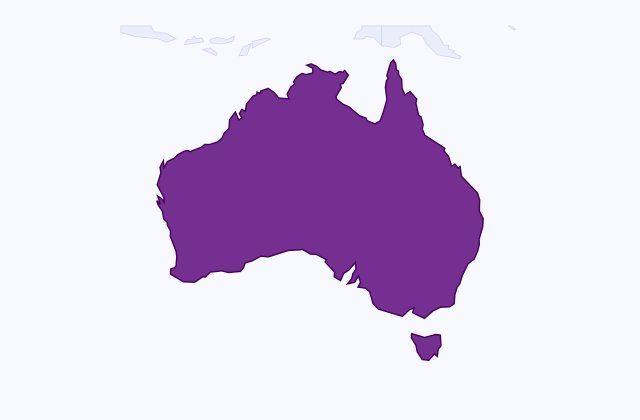
The legal framework
Australian childcare support runs through the Child Care Subsidy, a means-tested payment made directly to approved providers and deducted from the family's fee. The subsidy percentage falls as family income rises and increases for second and subsequent children in care. The former activity test, which linked subsidised hours to hours of work or study, has been replaced from January 2026 by a guaranteed minimum entitlement of three days a week of subsidised care for every eligible family. Services are regulated under the National Quality Framework and rated publicly.
The activity test had a perverse effect that drove the reform: families with the least stable work — casual, seasonal, unemployed — received the fewest subsidised hours, precisely the households for whom early education has the greatest benefit. The three-day guarantee removes that.
The National Quality Framework rating is genuinely useful and published for every service. A rating of Exceeding on a service you can actually reach is worth more than a long commute to a better-known name.
Out-of-pocket cost varies less than headline fees suggest, because the subsidy percentage moves with income. The figure to compare between services is the daily gap fee, which a service will quote if asked.
Key points
| Child Care Subsidy | Means-tested, paid directly to approved providers |
|---|---|
| Three-day guarantee | Minimum of 72 subsidised hours a fortnight from January 2026, regardless of activity |
| Higher rate | Increased subsidy for second and subsequent children in care |
| Quality | National Quality Framework ratings, published for every service |
| Options | Long day care, family day care, outside school hours care, in-home care |
| Preschool | Funded preschool or kindergarten programmes in the year before school, by state |
In practice
- Claim the Child Care Subsidy through myGov and Centrelink before your child starts, and confirm your income estimate.
- Choose an approved provider: only approved services attract the subsidy.
- Check the service's National Quality Framework rating and its most recent assessment.
- Update your income estimate during the year to avoid an end-of-year debt.
- Look at family day care as well as centres — it is subsidised on the same basis and often more flexible.
Cost and coverage
Long day care commonly costs AUD 130 to 190 a day before subsidy, more in inner Sydney and Melbourne. After the Child Care Subsidy, the out-of-pocket amount for a middle-income family is typically a fraction of that. Family day care is often somewhat cheaper, and outside school hours care much cheaper.
Recent changes
The replacement of the activity test by a guaranteed three days of subsidised care, effective January 2026, is the most significant change in a decade and particularly affects families with irregular or casual work.
Where to go
- Services Australia and myGov, for the Child Care Subsidy claim
- Starting Blocks, the national portal for finding and comparing services
- Australian Children's Education and Care Quality Authority, for ratings
- State education departments, for funded preschool programmes
- Family day care schemes in your area
Worth knowing
The subsidy is reconciled against actual income at the end of the financial year: an under-estimated income produces a debt, and it is the most common problem families encounter.
Frequently asked questions
What is the three-day guarantee?
From January 2026, every eligible family receives at least 72 hours of subsidised care a fortnight, regardless of hours of work or study.
How is the subsidy paid?
Directly to the approved provider, which deducts it from your fee; you pay the gap.
What happens if I under-estimate my income?
You will owe the difference at reconciliation after the financial year. Update your estimate whenever your income changes.
Where can I compare services?
On Starting Blocks and the national quality ratings register, which publishes each service's assessment.
Official sources and links
- Federal Register of Legislation — Commonwealth law as made and in force
- Services Australia — government services and payments