
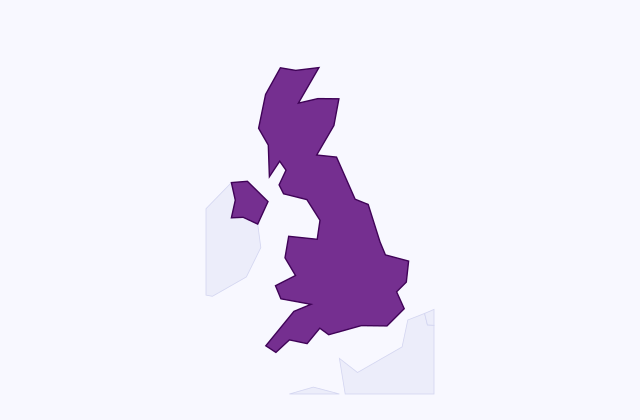
The legal framework
The Misuse of Drugs Act 1971 divides controlled drugs into Classes A, B and C. Possession of a Class A drug carries up to seven years' imprisonment and an unlimited fine; Class B up to five years; Class C up to two years. Supply or production carries up to life for Class A and up to fourteen years for Classes B and C. The Psychoactive Substances Act 2016 separately bans the production and supply of any substance capable of producing a psychoactive effect, without needing to schedule each molecule.
Cannabis is Class B. In practice a first offence of simple possession often results in a warning or a community resolution rather than a charge, but that is police discretion, not a legal entitlement, and it varies between forces.
Nitrous oxide was reclassified as a Class C drug in November 2023: possession for a psychoactive effect is now an offence, with up to two years for possession and up to fourteen years for supply.
Driving with a specified drug above a limit is a separate offence under section 5A of the Road Traffic Act 1988, with limits set at very low levels for illicit drugs.
Synthetic cannabinoids are Class B and were among the reasons for the 2016 Act: scheduling them one by one had proved impossible.
Key points
| Main statute | Misuse of Drugs Act 1971; Psychoactive Substances Act 2016 |
|---|---|
| Class A possession | Up to 7 years and an unlimited fine |
| Class B possession | Up to 5 years (cannabis, amphetamines, ketamine) |
| Class C possession | Up to 2 years (including nitrous oxide since November 2023) |
| Supply, Class A | Up to life imprisonment |
| Driving | Section 5A limits, very low for illicit drugs |
In practice
- FRANK gives confidential information and a service finder, on 0300 123 6600, around the clock.
- Local drug and alcohol services are free at the point of use and accept self-referral without a GP letter.
- Needle and syringe programmes and naloxone supply operate through pharmacies and outreach services.
Cost and coverage
Treatment through commissioned services is free. Fines are set by the court; an unlimited fine is possible for Class A possession.
Recent changes
Nitrous oxide control has changed the picture for young people, who were the main users; the reclassification was contested by the Government's own advisory council.
Where to go
- FRANK, 0300 123 6600, 24 hours.
- Local authority drug and alcohol services (self-referral).
- Turning Point, Change Grow Live and Via, service providers across England.
- Emergencies: 999; NHS 111 for advice.
Worth knowing
A caution or conviction for possession appears on an enhanced criminal record check and can affect employment, visas for the United States and Australia, and professional registration.
Frequently asked questions
Is cannabis decriminalised in the United Kingdom?
No. It is a Class B drug. A first simple possession is often dealt with out of court, but that is discretion, not a right.
Is nitrous oxide illegal?
Since November 2023 it is a Class C drug and possession for a psychoactive effect is an offence.
Is there a drink-drive style limit for drugs?
Yes, but the limits for illicit drugs are set at essentially zero-tolerance levels.
Official sources and links
- GOV.UK — official portal for public services and rights
- legislation.gov.uk — the statute book as enacted and revised