
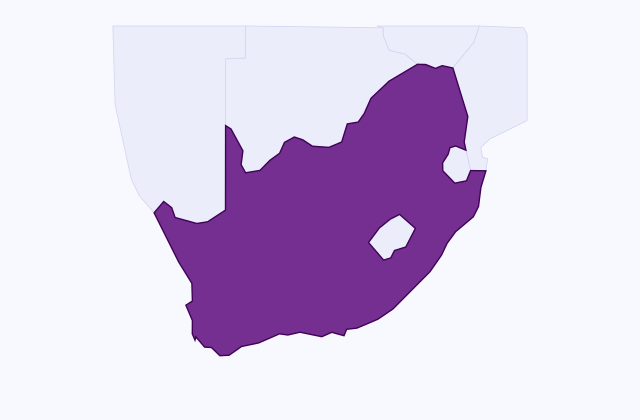
The legal framework
Assisted reproduction is governed by Chapter 8 of the National Health Act and the Regulations Relating to Artificial Fertilisation of Persons of 2012, which cover donor screening, record keeping and the confidentiality of donor identity. Access is not restricted by marital status or sexual orientation. Surrogacy is regulated separately by Chapter 19 of the Children's Act 38 of 2005: the agreement must be confirmed by the High Court before conception, at least one commissioning parent must be genetically related to the child, and only expenses may be paid.
The combination is unusual: liberal access rules, compensated egg donation within limits, and a surrogacy regime that is strict but workable because a court settles parentage before anyone is pregnant. Most countries have one of these features, rarely all three.
Donor identity is confidential under the 2012 regulations, which is increasingly out of step with international practice and with the reality of consumer DNA testing. Donor-conceived South Africans have begun to press for change.
Access in practice is shaped by money, not law. Public IVF exists at a handful of academic hospitals with long waiting lists, so the great majority of treatment is private, which excludes most of the population. This is the gap the law does not address.
Same-sex couples: access is open, and section 40 of the Children's Act recognises both partners as parents where artificial fertilisation was used with consent. Surrogacy is governed by a court-confirmed agreement and is open to same-sex couples.
Key points
| Law | National Health Act Chapter 8; Regulations Relating to Artificial Fertilisation 2012 |
|---|---|
| Access | No restriction by marital status or sexual orientation |
| Donation | Identity kept confidential; compensation for donors permitted within limits |
| Surrogacy | Children's Act Chapter 19; High Court confirmation before conception |
| Genetic link | At least one commissioning parent must be genetically related to the child |
| Sector | Mainly private; limited public provision at academic hospitals |
In practice
- Get a referral to a fertility clinic; public provision exists at a few academic hospitals but is heavily oversubscribed.
- Complete the work-up as a couple or individually.
- For donor gametes, work with a registered egg donor agency or sperm bank operating under the 2012 regulations.
- For surrogacy, instruct an attorney: the agreement must be confirmed by the High Court before conception or it is void.
- Plan the financing, since most treatment is private and medical schemes cover little.
Cost and coverage
An IVF cycle costs R 50,000 to R 90,000 including medication; ICSI and donor eggs add to that, with donor compensation of around R 10,000. Medical schemes typically cover investigations but not the cycle itself. South Africa is comparatively inexpensive by European standards and attracts patients from across the continent and from Europe.
Recent changes
South Africa's surrogacy framework, tested repeatedly in the Constitutional Court, remains among the clearest in the world, and the country has become a destination for intended parents from jurisdictions where surrogacy is prohibited — subject to the residence requirements the courts apply.
Where to go
- Private fertility clinics in Johannesburg, Pretoria, Cape Town and Durban
- Groote Schuur, Tygerberg, Charlotte Maxeke and Steve Biko academic hospitals, for limited public treatment
- Registered egg donor agencies and sperm banks
- Southern African Society of Reproductive Medicine and Gynaecological Endoscopy
- High Court, for confirmation of surrogate motherhood agreements
Worth knowing
A surrogacy agreement not confirmed by the High Court before conception is invalid, and the child would be the surrogate's in law — the single most important rule in South African surrogacy.
Frequently asked questions
Can single women and same-sex couples access IVF in South Africa?
Yes. There is no restriction by marital status or sexual orientation.
How does surrogacy work?
Under Chapter 19 of the Children's Act: the agreement must be confirmed by the High Court before conception, at least one commissioning parent must be genetically related to the child, and only expenses may be paid.
Are egg donors paid?
They receive compensation within limits — around R 10,000 — rather than a commercial fee.
What does a cycle cost?
R 50,000 to R 90,000 including medication, more for ICSI or donor eggs.
Is donor identity disclosed to the child?
No. The 2012 regulations require confidentiality of donor identity, though this is increasingly debated.
Official sources and links
- gov.za — official government portal
- South African Human Rights Commission — constitutional rights body