
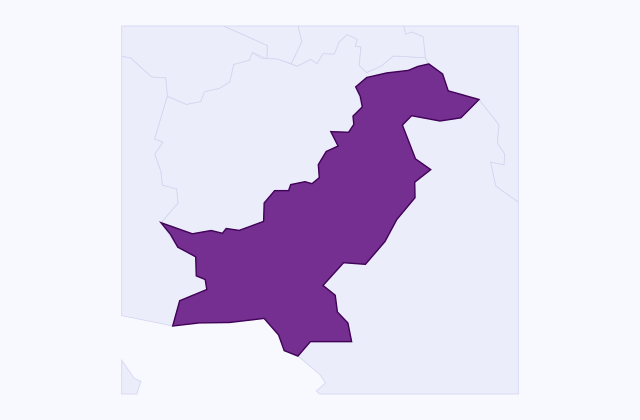
The legal framework
Pakistan has no comprehensive law on assisted reproduction. Clinics operate under general medical regulation and the oversight of provincial healthcare commissions, and professional practice follows the position of the Council of Islamic Ideology and mainstream Sunni jurisprudence: treatment is permissible for a married couple using their own gametes, while third-party donation and surrogacy are not. IVF and ICSI are widely practised in Karachi, Lahore, Islamabad and other cities, entirely in the private sector.
Without a statute, the practical protection for patients comes from choosing the centre carefully. The questions that matter are concrete: is there a full-time embryologist, how many cycles does the laboratory perform each year, what is the witnessing procedure for gametes and embryos, and what happens to surplus embryos.
Male factor infertility is very common and often diagnosed late because the assumption within families falls on the woman. A semen analysis costs little and takes a day; insisting on it at the first consultation shortens the path considerably.
Consanguineous marriage is frequent in Pakistan, which raises the value of genetic counselling for couples with a family history of inherited disease. Preimplantation testing is available in some centres but expensive, and the counselling matters more than the technology.
Same-sex couples: assisted reproduction is available to married heterosexual couples.
Key points
| Law | No dedicated ART statute; general medical regulation |
|---|---|
| Access | Married couples using their own gametes |
| Donation | Not accepted under the dominant religious position |
| Surrogacy | Not recognised; judicially contested |
| Sector | Private; no public funding |
| Oversight | Provincial healthcare commissions |
In practice
- Have both partners investigated; semen analysis should be among the first tests, not the last.
- Treat what is treatable: infections, varicocele, ovulation disorders, thyroid disease.
- Choose a clinic registered with the provincial healthcare commission and ask about its embryologist.
- Obtain a written estimate that includes medication, which is a large share of the cost.
- Agree in advance how many cycles are financially realistic.
Cost and coverage
An IVF cycle costs PKR 400,000 to 800,000 including medication, and ICSI more. There is no public funding and insurance rarely covers fertility treatment. Costs are low by international standards, which attracts patients from the Gulf and from the diaspora.
Recent changes
Draft legislation on assisted reproduction has been discussed for several years without being enacted, leaving clinic quality and the handling of gametes to vary considerably between centres.
Where to go
- Private ART centres in Karachi, Lahore, Islamabad, Rawalpindi and Peshawar
- Teaching hospitals for the diagnostic work-up
- Provincial healthcare commissions, for clinic registration
- Pakistan Society of Obstetricians and Gynaecologists
- Council of Islamic Ideology, for the religious position on third-party involvement
Worth knowing
Clinics that offer donor gametes or surrogacy operate outside both the religious consensus and any legal framework, and the child's parentage would be highly uncertain.
Frequently asked questions
Is there a law on IVF in Pakistan?
No dedicated statute. Clinics operate under general medical regulation and provincial healthcare commissions.
Are donor eggs or sperm used?
Not under the dominant religious position, which permits treatment only for a married couple using their own gametes.
What does a cycle cost?
PKR 400,000 to 800,000 including medication, more for ICSI.
Is surrogacy recognised?
No. It is not provided for in law and has been judicially contested; parentage would be very uncertain.
How do I choose a clinic?
Ask about the full-time embryologist, annual cycle numbers, witnessing procedures for gametes, and get a written estimate including drugs.
Official sources and links
- Government of Pakistan — official government portal