
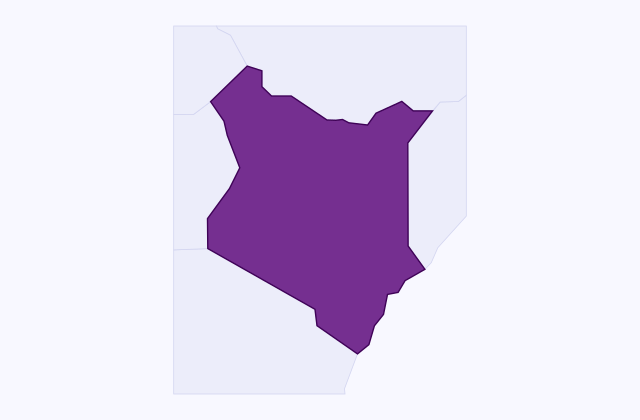
The legal framework
Kenya's Health Act 2017 acknowledges the right to reproductive health care including assisted reproduction, but the detailed framework — licensing of clinics, donor records, surrogacy, embryo storage — is left to a dedicated Assisted Reproductive Technology Bill that has been before Parliament in successive sessions without being enacted. In the meantime clinics operate under the Kenya Medical Practitioners and Dentists Council, and treatment is private, concentrated in Nairobi with a smaller presence in Mombasa and Eldoret.
Kenya sits in an awkward middle position: the technical capacity exists and results in the better Nairobi centres are respectable, but the legal framework that would protect patients and children does not. Donor records, family limits and embryo disposition are matters of clinic policy.
Surrogacy has repeatedly reached the courts, typically when a hospital or the registrar has refused to record the intended parents on the birth certificate. Judges have resolved individual cases in the child's interest, but no general rule has emerged.
As across the region, tubal disease after infection dominates among women and male factor is under-investigated. A semen analysis at the first consultation remains the single most useful and least expensive test in the whole pathway.
Same-sex couples: assisted reproduction is offered privately to heterosexual couples.
Key points
| Law | Health Act 2017; dedicated ART Bill still pending |
|---|---|
| Regulation | Kenya Medical Practitioners and Dentists Council |
| Sector | Private; no public funding for IVF |
| Donation | Practised without a statutory register or family limit |
| Surrogacy | No statutory framework; parentage contested in the courts |
| Centres | Nairobi principally, with centres in Mombasa and Eldoret |
In practice
- Start with a full couple work-up, semen analysis included.
- Treat infections and tubal disease where treatable, and correct ovulation disorders.
- Choose a clinic and ask for its annual cycle numbers and its embryologist's credentials.
- Get a written quotation covering medication, freezing and storage.
- For donor or surrogacy arrangements, take legal advice — the absence of a statute leaves parentage uncertain.
Cost and coverage
An IVF cycle costs KES 400,000 to 700,000 including medication, and ICSI more. There is no NHIF cover for IVF. The cost is far beyond median household income, and most patients fund a single attempt.
Recent changes
Successive versions of the ART Bill have sought to license clinics, create a donor register and regulate surrogacy; none has become law, so the questions the Bill addresses remain unanswered.
Where to go
- Private fertility centres in Nairobi, including those attached to the main private hospitals
- Kenyatta National Hospital and university teaching hospitals, for the work-up
- Kenya Medical Practitioners and Dentists Council, for practitioner registration
- Kenya Obstetrical and Gynaecological Society
- Regional centres in South Africa and India, used for techniques unavailable locally
Worth knowing
Surrogacy has no statutory basis in Kenya and has produced litigation over birth registration: do not proceed without legal advice and a clear plan for establishing parentage.
Frequently asked questions
Is IVF regulated in Kenya?
Only partially. The Health Act 2017 recognises assisted reproduction, but the detailed ART Bill has not been enacted.
What does a cycle cost?
KES 400,000 to 700,000 including medication, more for ICSI.
Is surrogacy legal?
There is no statutory framework. Cases have reached the courts over birth registration, and legal advice is essential.
Does NHIF cover IVF?
No. Treatment is entirely self-funded.
Where are the clinics?
Mainly in Nairobi, with some provision in Mombasa and Eldoret.
Official sources and links
- eCitizen — official government services portal