
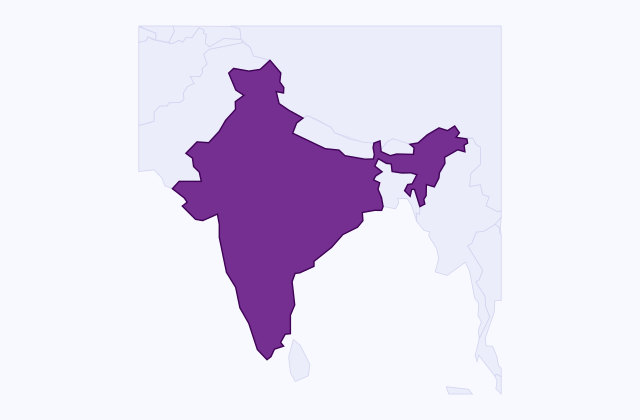
The legal framework
The Assisted Reproductive Technology (Regulation) Act 2021 and the Surrogacy (Regulation) Act 2021 came into force in January 2022. Every clinic and gamete bank must register on the national registry. Treatment is open to married heterosexual couples and to women who are widowed or divorced, with age limits of 21 to 50 for women and 21 to 55 for men. Commercial surrogacy is prohibited; only altruistic surrogacy by a willing woman is permitted, under strict conditions. Donors are recruited only through registered ART banks, and a woman may donate eggs once in her lifetime.
India's commercial surrogacy industry, at its peak, was estimated in the billions of rupees and involved thousands of arrangements a year, many with foreign intended parents. Reports of poor conditions and inadequate consent drove the legislation, which went further than most expected.
The once-in-a-lifetime limit on egg donation is unusual and consequential. Elsewhere donors may donate several times, which is how banks build supply; India's rule, combined with the requirement to use registered banks, has made donor eggs scarcer and more expensive.
The exclusion of single, unmarried and same-sex people has made the Acts constitutionally contested. Several petitions have been filed, and the position may change; anyone planning treatment should check the current state of the litigation.
Same-sex couples: the Assisted Reproductive Technology (Regulation) Act 2021 and the Surrogacy (Regulation) Act 2021 restrict access to married heterosexual couples and, for ART, to single women within an age range. Same-sex couples are excluded by statute.
Key points
| Statutes | ART (Regulation) Act 2021; Surrogacy (Regulation) Act 2021, in force January 2022 |
|---|---|
| Access | Married heterosexual couples; widowed or divorced women; age 21-50 (women), 21-55 (men) |
| Donation | Only through registered ART banks; a woman may donate once in her lifetime |
| Surrogacy | Altruistic only; commercial surrogacy prohibited |
| Registry | National Registry of ART clinics and banks |
| Insurance | Mandatory insurance cover for egg donors and surrogates |
In practice
- Choose a clinic registered on the National Registry and verify the registration number.
- Complete the couple work-up; both partners must be investigated.
- Sign the statutory consent forms, which are prescribed by the Act.
- For donor gametes, the clinic must source them from a registered ART bank, not privately.
- For surrogacy, obtain the eligibility and essentiality certificates required by the Surrogacy Act.
Cost and coverage
An IVF cycle costs ₹1.5 to ₹3 lakh including medication, and ICSI more. Donor egg cycles cost more again. There is no public funding, and most health insurance policies exclude fertility treatment, though a few now offer limited cover. India remains inexpensive by international standards, which historically drew large numbers of foreign patients.
Recent changes
The 2021 Acts ended India's role as the world's largest commercial surrogacy destination, a trade that had already been closed to foreigners in 2015. Enforcement of clinic registration has tightened, and unregistered clinics face penalties.
Where to go
- Registered ART clinics and banks listed on the National Registry
- National and State ART and Surrogacy Boards
- Indian Council of Medical Research, for guidelines
- Indian Society for Assisted Reproduction, for professional standards
- District medical boards, which issue surrogacy certificates
Worth knowing
The Acts exclude single men, unmarried couples and same-sex couples from ART and surrogacy; litigation on these exclusions is continuing before the courts.
Frequently asked questions
Who can access IVF in India?
Married heterosexual couples and women who are widowed or divorced, within the age limits of 21-50 for women and 21-55 for men.
Is commercial surrogacy legal?
No. It was banned by the Surrogacy (Regulation) Act 2021; only altruistic surrogacy is permitted, under strict conditions.
How often can a woman donate eggs?
Once in her lifetime, under the ART (Regulation) Act 2021, and only through a registered ART bank.
What does a cycle cost?
₹1.5 to ₹3 lakh for IVF including medication; more for ICSI or donor eggs.
How do I check a clinic is legitimate?
Verify its entry on the National Registry of ART clinics and banks; treatment at an unregistered clinic is unlawful.
Official sources and links
- India.gov.in — national portal of India
- India Code — central and state legislation