
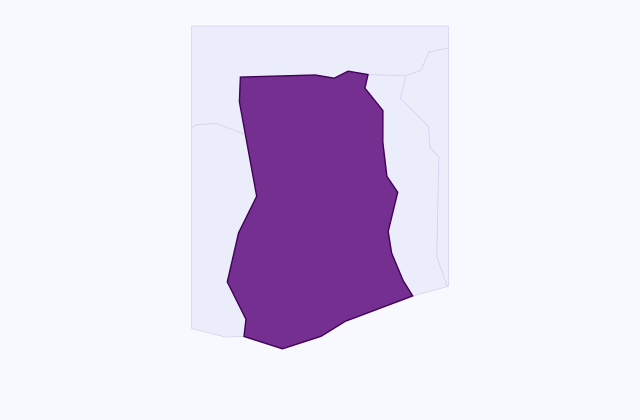
The legal framework
Ghana has no specific legislation on assisted reproduction. Clinics operate under the Health Institutions and Facilities Act and the registration requirements of the Medical and Dental Council, with professional guidance from the Ghana Fertility Society and the obstetric society. IVF has been performed in Accra since the 1990s, and the country now has one of the more mature private fertility sectors in West Africa, attracting patients from neighbouring countries and from the diaspora.
Ghana's fertility sector is mature by regional standards, with centres that have been operating for two decades and staff trained abroad. The practical consequence is that patients from Togo, Côte d'Ivoire, Nigeria and Burkina Faso travel to Accra.
Tubal factor infertility remains the leading female cause, a legacy of untreated infection and unsafe abortion, and it responds well to IVF. Male factor is common and under-investigated, as everywhere in the region.
Because the diaspora funds a large share of treatment, many cycles are scheduled around visits home. The monitoring schedule is the constraint: three to five scans over ten to twelve days, then the collection, which cannot be moved.
Same-sex couples: assisted reproduction is offered privately to heterosexual couples.
Key points
| Law | No dedicated ART statute; general health facility regulation |
|---|---|
| Regulation | Medical and Dental Council; Health Facilities Regulatory Agency |
| Sector | Private; no public funding |
| Donation | Practised without a statutory register or family limit |
| Surrogacy | Practised without a statutory framework |
| Centres | Accra principally, with provision in Kumasi and Takoradi |
In practice
- Complete a full couple work-up including semen analysis before considering IVF.
- Treat tubal infection, fibroids and ovulation disorders where treatment is possible.
- Check the clinic's registration with the Health Facilities Regulatory Agency.
- Ask about annual cycle volume, the embryologist and age-banded live birth rates.
- Get a written quotation including medication, freezing and storage fees.
Cost and coverage
An IVF cycle costs GHS 35,000 to 70,000 including medication, with ICSI and donor cycles higher. The National Health Insurance Scheme does not cover IVF. Ghanaian costs remain well below European levels, which underpins the inbound flow from the sub-region.
Recent changes
The sector has professionalised, with several centres investing in full-time embryology and quality systems; legislation to license ART specifically has been discussed but not passed.
Where to go
- Fertility centres in Accra, and provision in Kumasi and Takoradi
- Korle Bu Teaching Hospital and Komfo Anokye Teaching Hospital, for the work-up
- Health Facilities Regulatory Agency, for facility registration
- Ghana Fertility Society and the Ghana Society of Obstetricians and Gynaecologists
- Diaspora patients often combine treatment with a planned visit; plan around the monitoring schedule
Worth knowing
Donor and surrogacy arrangements have no statutory basis: parentage depends on the birth registration and on contract, which is a weak foundation.
Frequently asked questions
Is IVF regulated in Ghana?
Not by a dedicated statute. Clinics are registered as health facilities and follow professional guidance.
What does a cycle cost?
GHS 35,000 to 70,000 including medication, higher for ICSI or donor cycles.
Does the NHIS cover IVF?
No. Treatment is entirely self-funded.
Are donor gametes available?
They are used, but without a statutory register or limit on families per donor.
How long do I need to be in Ghana for a cycle?
Around two to three weeks, covering monitoring, collection and transfer.
Official sources and links
- Ghana.gov — official government portal