
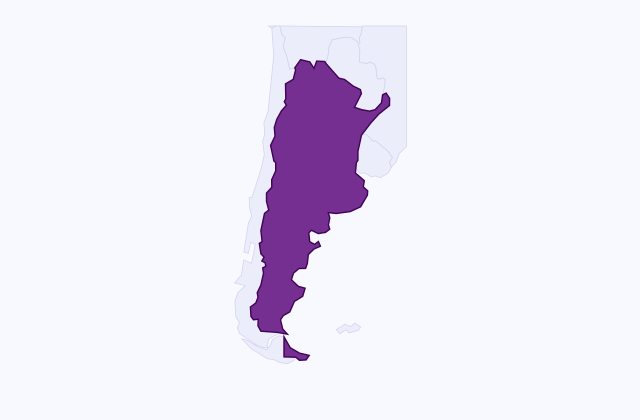
The legal framework
Law 27.610, passed on 30 December 2020 and in force since 24 January 2021, recognises the right to the voluntary termination of pregnancy (interrupción voluntaria del embarazo, IVE) up to and including the fourteenth week, and keeps legal termination (interrupción legal del embarazo, ILE) with no time limit when the pregnancy results from rape or endangers the life or the integral health (salud integral) of the pregnant person; in the case of rape, a sworn statement (declaración jurada) is enough. The law sets a maximum of ten days from the request for the procedure to be carried out, forbids conscientious objection by institutions — only individual practitioners may object, never in an emergency, and the facility must then refer the patient at once — and obliges obras sociales and prepagas to cover the procedure under the Programa Médico Obligatorio (PMO, the compulsory basic package of care). From 16 a person decides alone; between 13 and 16, with the support of an adult of reference (adulto de referencia), without the parents being needed. Medication abortion — misoprostol, combined with mifepristone since 2023 — is used up to 12 weeks, and manual vacuum aspiration afterwards. Beyond the fourteenth week and outside the legal grounds, abortion remains an offence, with reduced penalties that are almost never applied. About 100,000 IVE and ILE procedures are carried out each year in the public system.
The vote of December 2020, after the mass mobilisations of the 'green wave' (marea verde) from 2018 onwards, made Argentina the first large country in Latin America to legalise abortion on request; Colombia and Mexico followed through their courts. For British and Irish women, the Argentine limit falls between those they know: fourteen weeks on request, against twelve in Ireland — with a three-day waiting period — and in Northern Ireland, and up to twenty-four weeks in England, Wales and Scotland under the Abortion Act 1967, which requires two doctors to agree that a legal ground is met rather than a simple request. The approach is otherwise familiar to British women: free care in the public system, no compulsory waiting period, medication abortion at home in the early weeks, and young women of 16 and 17 who decide alone, as they can in the UK.
A British or Irish woman living in Argentina, or passing through, has access to the IVE like anyone else: the law sets no nationality condition, residents use their obra social, their prepaga or the public system, and a visitor goes to a public hospital or health centre with her passport — since Decree 366/2025, hospitals run by the national government may charge non-resident foreigners for non-emergency care, and the provinces set their own rules — so she should ask when booking whether non-residents are charged, since travel insurance does not cover an abortion. The real difficulties are not legal but geographical — the northern provinces lack practitioners who do not object — and, since 2024, budgetary. Past fourteen weeks, only the ILE grounds remain in Argentina; Great Britain is a long and costly journey away, and free NHS treatment there depends on being ordinarily resident in the UK.
Key points
| IVE | Up to and including the fourteenth week, on request, without having to give reasons |
|---|---|
| ILE | No time limit after rape (a sworn statement is enough) or where life or integral health is at risk |
| Time to treatment | Ten calendar days at most from the request |
| Minors | From 16 they decide alone; between 13 and 16, with an adult of reference, without the parents |
| Conscientious objection | Individual only; the facility must refer the patient at once; prohibited in an emergency |
| Cover | Compulsory: public system, obras sociales, prepagas (Programa Médico Obligatorio) |
| Methods | Misoprostol and mifepristone (combination available since 2023) up to 12 weeks; manual vacuum aspiration afterwards |
| Figures | About 100,000 IVE/ILE a year in the public system |
| British and Irish women | No nationality condition; 14 weeks on request, against 12 in Ireland and Northern Ireland and 24 weeks on legal grounds in Great Britain; not covered by travel insurance |
In practice
- Book an appointment at a public health centre or hospital, or call the Ministry of Health's sexual health line, 0800 222 3444, which gives the nearest facility (efector); a foreign woman needs only her passport.
- In most cases a single consultation: ultrasound, information and the medication for treatment at home, with a check 10 to 14 days later — a visitor should plan to stay in Argentina until then.
- Obras sociales and prepagas must cover the procedure without any co-payment; a refusal is reported to the Superintendencia de Servicios de Salud (the health insurance regulator).
- In the northern provinces real access remains harder (fewer facilities, more objectors): the Red de Profesionales de la Salud por el Derecho a Decidir (network of health professionals for the right to decide) and Socorristas en Red, a feminist support network, guide women to a provider.
- Make the request in writing where you can and keep a copy: the ten-day limit runs from it.
Cost and coverage
Free in the public system and without co-payment with an obra social or prepaga. In a private consultation the medication costs between 30,000 and 80,000 pesos depending on the pharmacy, on top of the consultation fee. Travel insurance does not cover an abortion.
Recent changes
Since 2024 Javier Milei's government has cut the purchase and distribution of misoprostol and the budget of the national programme, and dissolved the Ministry of Women; the law remains in force, and several provinces (Buenos Aires, Santa Fe, Córdoba) buy the medication themselves. Access therefore depends more than before on the province and the facility.
Where to go
- Ministry of Health sexual health line: 0800 222 3444 (free, nationwide).
- Public hospitals and health centres: list of guaranteed facilities on argentina.gob.ar.
- Red de Profesionales de la Salud por el Derecho a Decidir and Socorristas en Red: support in every province.
- Superintendencia de Servicios de Salud: complaints against obras sociales and prepagas (0800 222 72583); British Embassy in Buenos Aires: consular assistance; Irish citizens: Embassy of Ireland in Buenos Aires.
Worth knowing
A sworn statement of rape is enough for an ILE without time limit: no police report and no evidence are required, and health staff may not demand them. Keep a copy of any written request: the ten-day limit runs from it. And the fourteen weeks are counted from the first day of the last period and include the whole fourteenth week, up to 14 weeks and 6 days: close to the limit, ask for an appointment at once rather than wait to travel home.
Frequently asked questions
I am a British visitor in Argentina and need an abortion — is it possible?
Yes. Law 27.610 applies to anyone in the country, with no condition of nationality or residence: up to and including the fourteenth week, without giving reasons and with no waiting period. Call 0800 222 3444 or go to a public hospital or health centre with your passport; in Buenos Aires care is usually arranged within the week. Since Decree 366/2025, national hospitals may charge non-residents for non-emergency care: ask when booking whether you will be charged; private clinics charge for the consultation and the medication, and travel insurance does not pay. Plan to stay for the check-up 10 to 14 days after a medication abortion.
I am 15 — do I need my parents?
No. From 16 you decide alone; between 13 and 16, with the support of an adult of reference, who need not be a parent, and health staff may not require your parents. In the UK, too, a girl under 16 can consent to treatment if she is judged mature enough to understand it (the Gillick principle).
What happens if a doctor refuses?
The doctor must say so at once, and the facility must arrange the procedure without delay with another practitioner: objection is individual, never institutional, and is prohibited in an emergency. A refusal or a delay beyond ten days can be reported to the hospital management or to the Superintendencia de Servicios de Salud (for obras sociales and prepagas), or challenged by an amparo (an urgent court action), which judges decide within days.
Official sources and links
- Law 27.610 — access to the voluntary termination of pregnancy — official text
- Ministry of Health — IVE/ILE — information and facilities
- Superintendencia de Servicios de Salud — complaints about cover
- British Embassy Buenos Aires — consular assistance
- argentina.gob.ar — official portal of the Argentine state: procedures, civil registry, migration, health, justice
- Normativa nacional (InfoLeg) — official texts of Argentine laws and decrees
- British Embassy Buenos Aires — gov.uk — consular help, notarial and documentary services for British nationals in Argentina