
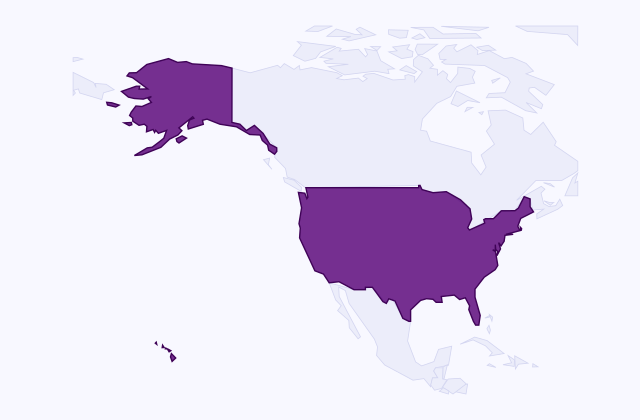
The legal framework
American privacy law is fragmented. The Fourth Amendment restrains the government, not private parties. Against private parties, most states recognise four privacy torts: intrusion upon seclusion, public disclosure of private facts, false light, and appropriation of name or likeness. Sectoral federal statutes cover health, finance and children, and states such as California, Colorado, Virginia and Texas have enacted comprehensive consumer privacy laws.
Key points
| Constitution | Binds government actors only; no horizontal effect between private parties |
|---|---|
| Common law | Four privacy torts, recognised with variations state by state |
| Sectoral statutes | HIPAA for health, GLBA for finance, COPPA for children, FERPA for education |
| State laws | California CCPA/CPRA and a growing number of comparable state statutes |
| Biometrics | Illinois BIPA allows private suits and has produced very large settlements |
| Regulator | Federal Trade Commission under its unfair-and-deceptive-practices power |
| Newsworthiness | A powerful defence: truthful information on matters of public concern is strongly protected |
| Public records | Information lawfully obtained from public records generally cannot found a claim |
| Wiretap laws | Recording rules differ: some states require all parties to consent |
In practice
- Send a written access request first: it forces the other side to disclose what it holds and creates a paper trail.
- Screenshot everything, with the date and the URL visible, before asking for removal.
- Complain to the regulator — it is free — and keep the reference number.
- Court action is the last step, and the limitation periods are short: take advice early.
- Check your state's recording law before taping a call: one-party and all-party rules both exist.
Where to go
- Federal Trade Commission, reportfraud.ftc.gov.
- State attorney general consumer protection division.
- Privacy plaintiffs' firms, usually on contingency.
Worth knowing
Your rights depend heavily on the state you live in, and sometimes on the state a company is based in. Check your own state's statute before assuming a right exists. Recording a conversation legally in one state can be a crime in another. Where the parties are in different states, the stricter rule usually applies.
Official sources and links
- USA.gov — official guide to government services
- Congress.gov — federal legislation