
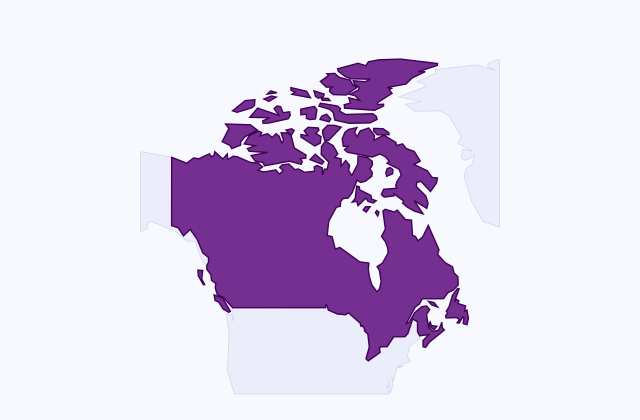
The legal framework
PIPEDA governs personal information in commercial activity federally, while Quebec, Alberta and British Columbia have their own substantially similar laws. In 2012 the Ontario Court of Appeal recognised the tort of intrusion upon seclusion in Jones v Tsige, and other provinces have statutory privacy torts actionable without proof of damage.
Key points
| Federal statute | PIPEDA, supervised by the Privacy Commissioner of Canada |
|---|---|
| Provincial statutes | Quebec, Alberta and British Columbia have their own regimes |
| Quebec | Law 25 has added notification, portability and de-indexing rights |
| Tort | Intrusion upon seclusion, recognised in Ontario in 2012 |
| Statutory torts | British Columbia, Manitoba, Saskatchewan and Newfoundland: actionable without proof of damage |
| Charter | Section 8 protects against unreasonable search by the state |
| Public disclosure tort | Recognised in Ontario in addition to intrusion upon seclusion |
| Internet harassment tort | Recognised by an Ontario court for sustained online campaigns |
| Criminal Code | Voyeurism and interception offences supplement the civil remedies |
In practice
- Send a written access request first: it forces the other side to disclose what it holds and creates a paper trail.
- Screenshot everything, with the date and the URL visible, before asking for removal.
- Complain to the regulator — it is free — and keep the reference number.
- Court action is the last step, and the limitation periods are short: take advice early.
- Where the conduct is sustained and targeted, plead harassment as well as privacy.
Where to go
- Office of the Privacy Commissioner of Canada.
- Provincial privacy commissioner.
- Provincial small claims court for modest damages.
Worth knowing
The federal Commissioner can make findings and recommendations but has limited power to fine; for a financial remedy you usually have to go to court. The Ontario courts have been the engine of Canadian privacy law. Decisions there are persuasive but not binding in other provinces.
Official sources and links
- Canada.ca — official government portal
- Justice Laws Website — federal statutes and regulations