
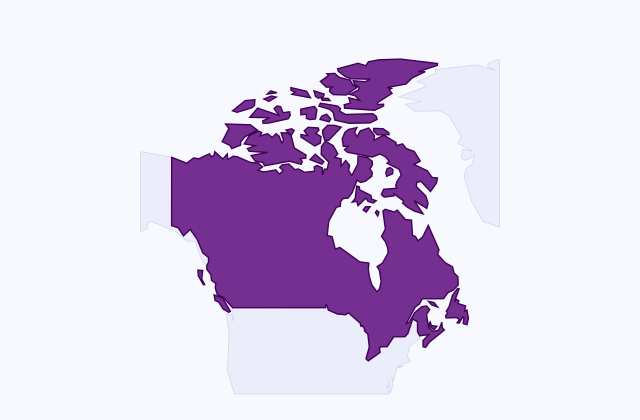
The legal framework
Federal law treats couples as common-law partners after one year of cohabitation for tax and benefits. Provincial law governs property and support, and diverges sharply: British Columbia treats two-year common-law couples as spouses for property division, Ontario grants support but no property sharing, and Quebec applies its own regime, including the parental union scheme in force since 30 June 2025.
Key points
| Federal (tax, benefits, immigration) | Common-law after 12 months of continuous cohabitation, or sooner with a child |
|---|---|
| British Columbia | Two years of cohabitation gives full spousal property rights |
| Ontario | Spousal support after three years, or with a child; no automatic property division |
| Alberta | Adult interdependent partners have support rights and, since 2020, property division |
| Quebec | No general regime; the parental union scheme applies to couples with a child born or adopted since 30 June 2025 |
| Death | Intestacy rules for common-law partners vary by province; several exclude them entirely |
| Federal recognition | Common-law status after one year for tax, benefits and immigration |
| Provincial divergence | Property rights differ sharply; Quebec has long excluded de facto couples |
| Quebec reform | A parental union regime now protects couples with children born after its entry into force |
| Support | Spousal support is available to common-law partners in most provinces |
In practice
- Find out what your specific province does — the differences are larger than most people expect.
- Sign a cohabitation agreement; it is enforceable everywhere with disclosure and independent advice.
- Make wills: in several provinces a common-law partner inherits nothing on intestacy.
- Update pension and RRSP beneficiary designations.
- Check your own province's rules: federal recognition does not create property rights.
- In Quebec, find out whether the parental union regime applies to your family.
Cost and coverage
Agreements and wills cost a few hundred to a couple of thousand dollars.
Recent changes
Quebec's parental union reform of 2025 narrowed the country's biggest gap, but only for couples who have a child after that date. Quebec introduced a parental union regime creating a protected family patrimony for unmarried parents.
Where to go
- Provincial family law information centres.
- Community legal clinics and legal aid.
- Éducaloi (Quebec) and equivalent public legal education bodies.
Worth knowing
Moving between provinces can change your legal position overnight: a couple treated as spouses in British Columbia may have no property rights at all after relocating to Ontario. Quebec's new parental union regime applies to couples with a child born after it came into force. Couples with older children remain outside it.
Official sources and links
- Canada.ca — official government portal
- Justice Laws Website — federal statutes and regulations