
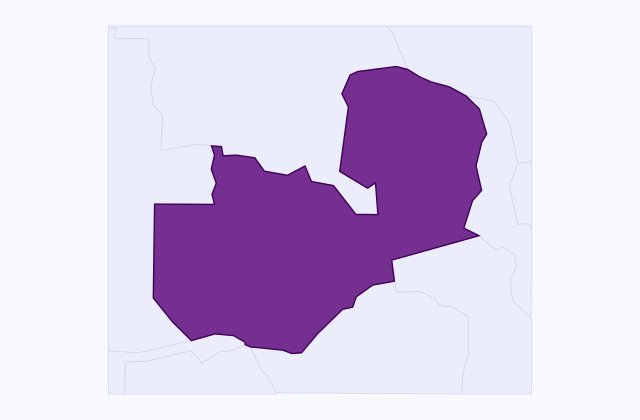
The legal framework
The Penal Code sets 16, with aggravated penalties for younger children, and the Anti-Gender-Based Violence Act 2011 provides protection orders and shelters. Fast-track GBV courts operate in several districts. One-stop centres in major hospitals provide medical, forensic and legal support.
Key points
| Age of consent | 16 |
|---|---|
| Definition | Set out in dedicated sexual offences legislation |
| Marital rape | Criminalised in some of these jurisdictions and not in others — check the national position |
| Medical care | Post-exposure prophylaxis for HIV must begin within 72 hours |
| Forensic evidence | Best collected within 72 hours, before washing or changing clothes if possible |
| Support | One-stop centres combine medical, police and counselling services |
| Penal Code Amendment 2005 | Strengthened sexual offence provisions, with minimum sentences |
| Age of consent 16 | Defilement covers anyone below that age |
| Victim Support Unit | Police units handling sexual and domestic violence |
| One-stop centres | Established at several hospitals |
In practice
- Report to the police at any station; you do not have to decide immediately whether to pursue a prosecution.
- A forensic medical examination can usually be carried out and stored before any decision to report.
- Specialist support services can attend with you and explain each step.
- Ask for written confirmation of any examination and of the report reference.
- Go to a one-stop centre where one exists: medical, police and counselling in one place.
- Ask for the Victim Support Unit at the police station.
Recent changes
The regional trend is towards one-stop centres, which have measurably improved both survivor experience and evidence quality compared with separate police and hospital processes.
Where to go
- One-stop centres and gender-based violence recovery units in public hospitals.
- Police units specialising in sexual and gender-based violence.
- National helplines and women's rights organisations providing legal accompaniment.
Worth knowing
Go to a hospital first, ideally within 72 hours: that window covers both HIV prophylaxis and forensic evidence. Reporting to the police can follow afterwards. Post-exposure prophylaxis must begin within 72 hours and is free at public facilities. Ask for it explicitly; it is not always offered.
Official sources and links
- World Health Organization — international reference on this topic
- WHO Regional Office for Africa — country data and programmes