
The legal framework
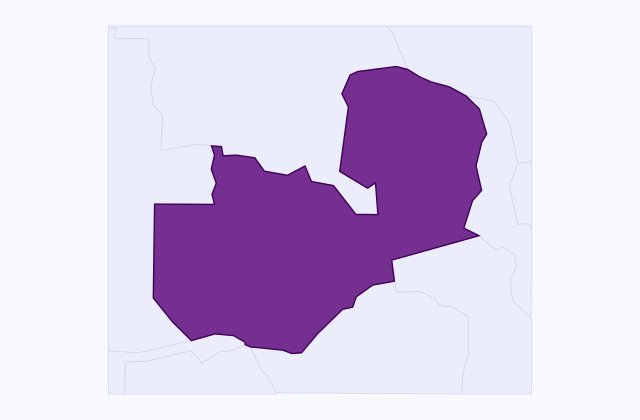
Legislation has been substantially modernised across the region. Zambia repealed its colonial-era Mental Disorders Act in 2019, replacing it with rights-based mental health legislation. Provision, however, remains concentrated in a handful of referral hospitals, and more than nine in ten people who need care receive none. The working strategy is integration into primary care: training nurses at health centres to recognise and treat the most common conditions, rather than building specialist hospitals.
Key points
| Legal framework | Recently modernised, rights-based, replacing colonial-era statutes |
|---|---|
| Treatment gap | More than nine in ten affected people receive no care |
| Strategy | Integration of mental health into primary care |
| Specialist provision | Concentrated in a few referral hospitals |
| Essential medicines | On the national list, with frequent stock-outs |
| Traditional healing | Commonly the first recourse |
| Chaining | Prohibited by the new statutes, still practised for lack of alternatives |
In practice
- Your nearest health centre can treat depression and anxiety: a referral hospital is not required.
- Medicines for epilepsy and psychosis are on the essential list - ask for them by name.
- Traditional healing and medical treatment can coexist, but one should not delay the other.
- Family and carer associations provide practical support and reliable information.
Cost and coverage
Health centre consultations cost little; essential medicines are in principle subsidised.
Where to go
- Health centres providing mental health care within primary care.
- Psychiatric units of regional and referral hospitals.
- Family, carer and community organisations.
Worth knowing
Restraining or confining a person in crisis is still common where no treatment is available. It reliably makes the condition worse, and simple treatment available at a health centre changes the picture within weeks.
Official sources and links
- World Health Organization — international reference on this topic
- WHO Regional Office for Africa — country data and programmes