
The legal framework
Specialist provision is concentrated in a few large cities and serves a small fraction of the need. Mental health legislation is devolved to the provinces, with uneven implementation. Stigma is a major barrier, particularly for women, and traditional or faith-based healing is often the first recourse. A handful of national helplines and non-governmental services provide free counselling.
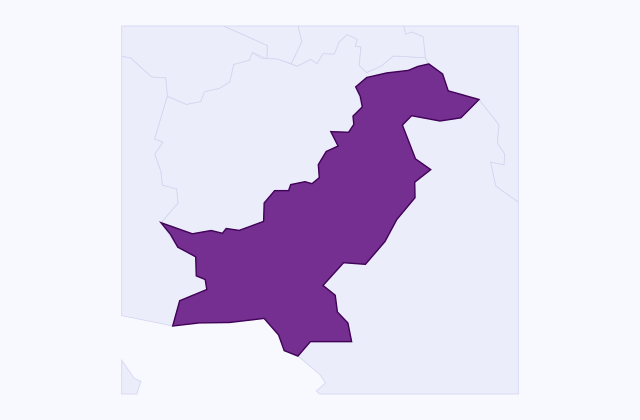
Specialist provision in Pakistan is very limited — a few hundred psychiatrists for a population of well over two hundred million — and concentrated in Karachi, Lahore and Islamabad. Stigma is strong, and distress is frequently presented as physical symptoms to a general practitioner. A small number of national helplines operate, and primary care integration is the realistic route to wider coverage.
Key points
| Provision | Concentrated in a few cities; very few practitioners per head of population |
|---|---|
| Legislation | Devolved to the provinces, with uneven implementation |
| Stigma | A major barrier, particularly for women seeking care |
| Faith healing | Often the first recourse, delaying medical care |
| Helplines | A small number of free national counselling lines |
| Medication | Essential psychotropics available in public hospitals |
| Cost | Public consultations are inexpensive; private care is out of reach for most |
In practice
- Public teaching hospitals have psychiatry departments and charge very little.
- Free national counselling helplines exist and are answered by trained volunteers.
- Faith-based support and medical treatment are not mutually exclusive, but one should not delay the other.
- Non-governmental organisations provide free counselling in several cities.
Cost and coverage
Public hospital consultations are inexpensive; helpline counselling is free.
Where to go
- Psychiatry departments of public teaching hospitals.
- Free national counselling helplines.
- Non-governmental mental health organisations.
Worth knowing
The gap between need and provision is one of the widest in the region. The public teaching hospitals are the most realistic route, and the cost of a consultation there is minimal.
Frequently asked questions
Where can someone get help in Pakistan?
Through the psychiatry departments of teaching hospitals in the major cities, which run outpatient clinics at low cost, through a small number of national helplines, and increasingly through telepsychiatry, which has extended reach into smaller cities. Basic health units can prescribe common medication.
Is attempted suicide still a crime?
No. The provision criminalising attempted suicide was repealed in 2022, which removed a significant deterrent to seeking help after a crisis. Attitudes have not shifted as fast as the law, so confidentiality is worth confirming with any service you approach.
Official sources and links
- Government of Pakistan — official government portal