
The legal framework
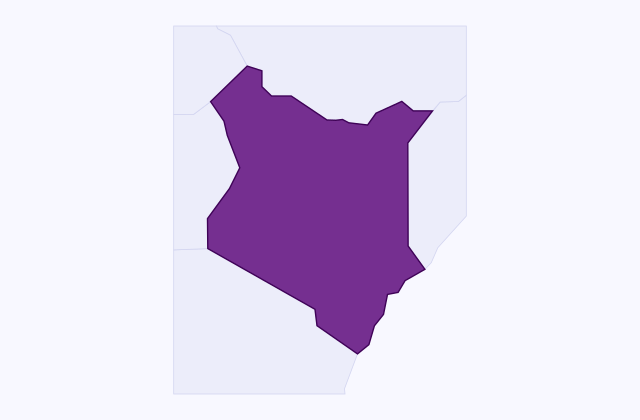
Legislation has been substantially modernised across the region. Kenya amended its mental health legislation in 2022, strengthening patients' rights and shifting the emphasis towards community care. Provision, however, remains concentrated in a handful of referral hospitals, and more than nine in ten people who need care receive none. The working strategy is integration into primary care: training nurses at health centres to recognise and treat the most common conditions, rather than building specialist hospitals.
Kenya amended its Mental Health Act in 2022, replacing outdated language, strengthening consent and creating a board to oversee services — a significant modernisation on paper. Delivery has not followed at the same pace: there are very few psychiatrists for the population, most are in Nairobi, and counties differ enormously in what they provide. Integration into primary care and a national suicide prevention strategy are the current direction.
Key points
| Legal framework | Recently modernised, rights-based, replacing colonial-era statutes |
|---|---|
| Treatment gap | More than nine in ten affected people receive no care |
| Strategy | Integration of mental health into primary care |
| Specialist provision | Concentrated in a few referral hospitals |
| Essential medicines | On the national list, with frequent stock-outs |
| Traditional healing | Commonly the first recourse |
| Chaining | Prohibited by the new statutes, still practised for lack of alternatives |
In practice
- Your nearest health centre can treat depression and anxiety: a referral hospital is not required.
- Medicines for epilepsy and psychosis are on the essential list - ask for them by name.
- Traditional healing and medical treatment can coexist, but one should not delay the other.
- Family and carer associations provide practical support and reliable information.
Cost and coverage
Health centre consultations cost little; essential medicines are in principle subsidised.
Where to go
- Health centres providing mental health care within primary care.
- Psychiatric units of regional and referral hospitals.
- Family, carer and community organisations.
Worth knowing
Restraining or confining a person in crisis is still common where no treatment is available. It reliably makes the condition worse, and simple treatment available at a health centre changes the picture within weeks.
Frequently asked questions
What changed in the 2022 amendment?
It replaced stigmatising terminology, strengthened the rules on consent and involuntary treatment, provided for care at county level and established a mental health board. It also framed mental health as part of universal health coverage rather than a separate institutional matter.
Where can someone get help?
At county referral hospitals, which have psychiatric units, at Mathari hospital in Nairobi for specialist care, and through a growing number of helplines and online counselling services. Attempted suicide was decriminalised by the High Court in 2022, which removed a real barrier to seeking care.
Official sources and links
- eCitizen — official government services portal